
Swap Ratio Determination for Mergers and Demergers: A Comprehensive Guide to Fair Share Exchange Valuation
 Saurobh Barick
on
Saurobh Barick
on
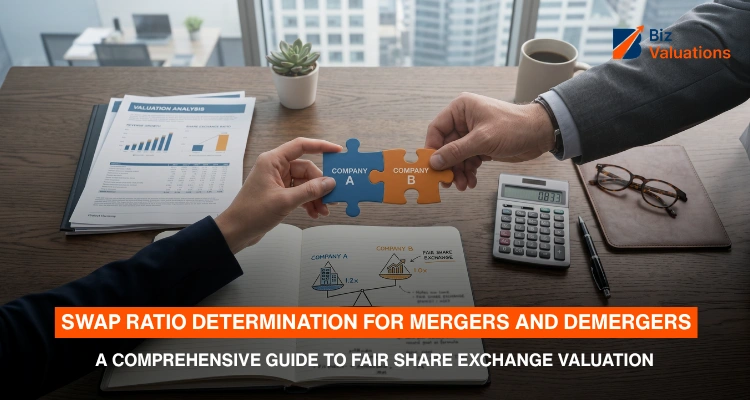
When two companies merge or a business split through a demerger, one number determines who gets what: the swap ratio. Also called the share exchange ratio, this figure dictates exactly how many shares shareholders of the transferor company receive in the resulting or acquiring entity. Get it right, and the transaction proceeds smoothly. Get it wrong, and you face shareholder objections, regulatory delays, NCLT challenges, and costly litigation.
India's corporate restructuring activity is growing rapidly. H1 2025 alone saw M&A deals worth USD 50 billion, with valuation expertise required at every step. Whether you are a CFO preparing a merger scheme, a board member approving a demerger, or a legal advisor filing with the NCLT, understanding how swap ratios are determined is not just useful: it is essential.
This guide walks you through everything. From the core valuation methodologies to India's regulatory framework, real-world challenges, and best practices that produce defensible outcomes.
Key Takeaways
- The swap ratio defines the share exchange proportion between companies in a merger or demerger. It directly affects ownership, voting rights, and shareholder wealth.
- No single formula exists. Professionals use multiple valuation approaches, including DCF, comparable company analysis, and net asset value, then reconcile findings into a defensible range.
- India's regulatory framework for swap ratios spans the Companies Act 2013, NCLT, SEBI ICDR Regulations, and Income Tax Act. Each layer adds requirements that must be met.
- Fairness opinions from SEBI-registered merchant bankers add governance strength and protect against shareholder challenges, especially in related-party or complex group transactions.
- Independent valuation is not optional in practice. NCLT and SEBI both scrutinize the basis of proposed ratios. An undocumented or poorly supported ratio invites rejection.
- Biz Valuations has completed 3,500+ certified valuation engagements across 35+ industries and holds both IBBI Registered Valuer and SEBI Category I Merchant Banker credentials, covering every mandatory and advisory context.
Defining the Swap Ratio and Its Strategic Significance
The swap ratio represents the proportional exchange of equity interests between companies involved in a restructuring. Consider a simple example: if Company A merges with Company B at a swap ratio of 2:3, every two shares held in Company A are exchanged for three shares in the merged entity.
This is not just an arithmetic exercise. The ratio carries profound implications:
- It determines each shareholder's ownership stake in the combined or resulting entity.
- It directly affects voting influence and participation in future profits.
- It signals to the market whether the deal is fair or whether one group of shareholders is being short-changed.
Institutional investors, minority shareholders, auditors, and lenders all examine the swap ratio for fairness. In India's evolving corporate environment, where restructuring activity continues to rise, a well-supported swap ratio often makes the difference between seamless execution and prolonged disputes.
Distinguishing Between Mergers and Demergers
Before diving into valuation mechanics, it helps to understand what each transaction structure actually involves.
Mergers involve the absorption of one or more entities into a single surviving company. The objectives typically include achieving economies of scale, accessing new markets, realizing cost synergies, or strengthening competitive positioning. Shareholders of the merging entity exchange their holdings for shares in the enlarged company. The swap ratio reflects the relative enterprise values of the combining businesses.
Demergers involve the separation of a specific business undertaking, division, or subsidiary into a new, distinct entity. Companies pursue demergers to unlock hidden value in diverse operations, enable focused management of individual business lines, raise targeted capital, or prepare a unit for listing or strategic sale. Shareholders typically receive proportional shares in the new entity, governed by a carefully calculated exchange ratio that accounts for the carved-out business's standalone value.
Both structures demand meticulous valuation. Any perceived inequity can derail approvals and trigger regulatory intervention.
Core Valuation Methodologies in Merger and Demerger Contexts
Income Approach
This forward-looking method centers on the present value of expected future benefits. The Discounted Cash Flow (DCF) technique is particularly influential for growth-oriented businesses. It involves building detailed financial projections covering revenue trajectories, margin trends, capital investments, working capital cycles, and terminal values.
A suitable discount rate, typically derived from the weighted average cost of capital (WACC) adjusted for company-specific and industry risks, brings these future flows to present value. DCF is most valuable when reliable forecasts are available. It also requires rigorous sensitivity testing to address uncertainties in key assumptions.
Market Approach
This method gauges value through observable market evidence. Two techniques are widely used:
Comparable Company Method: Analyzes trading multiples such as EV/EBITDA, P/E, or price-to-book of similar listed peers. Appropriate adjustments are made for differences in size, profitability, risk, and growth.
Comparable Transaction Method: Reviews multiples from recent M&A deals in the same or adjacent sectors, offering insight into what acquirers have actually paid in arm's-length situations.
These approaches anchor valuations in real-time market sentiment but require careful selection of truly comparable companies or transactions.
Asset-Based Approach
Particularly suited to asset-heavy sectors like manufacturing, real estate, infrastructure, or holding companies, this method calculates net asset value by revaluing tangible and intangible assets to current fair market levels and subtracting liabilities.
It frequently serves as a floor valuation and gains prominence in demergers involving specific asset bundles, or when earnings-based methods face limitations due to cyclical performance or early-stage operations.
In practice, valuers reconcile outputs from all three methodologies, assigning weights based on the company's nature, data availability, and transaction purpose.
Swap Ratio Calculation: Key Financial Parameters
While no single formula applies to every situation, the following financial parameters typically feed into the swap ratio analysis:
| Parameter | Role in Swap Ratio Determination |
|---|---|
| Earnings Per Share (EPS) | Reflects profitability per share; higher EPS typically supports a stronger ratio |
| Book Value Per Share | Provides an asset-based floor, especially for capital-intensive businesses |
| Market Price Per Share | Key input for listed companies; reflects prevailing investor sentiment |
| EV/EBITDA Multiple | Enterprise value relative to operating earnings; widely used in market approach |
| DCF Value Per Share | Intrinsic value based on projected future cash flows; key for unlisted entities |
| Dividend Yield | Relevant where income distribution history is significant |
| Net Asset Value (NAV) | Used for asset-heavy companies or holding structures |
Valuers apply each of these across both entities involved and then determine the relative ratio. For example, if Company A's DCF value per share is Rs. 100 and Company B's is Rs. 150, the indicative ratio would be 3:2 (three shares of A for two shares of B), subject to further adjustments.
Factors Shaping Swap Ratio Outcomes
Beyond pure financial metrics, several qualitative and quantitative elements influence final ratios:
- Profitability and cash generation: Consistent cash flow generation supports higher valuation multiples and therefore a stronger ratio in negotiations.
- Growth prospects: New markets, innovation pipelines, or favorable industry tailwinds enhance perceived future value and shift the ratio accordingly.
- Competitive advantages: Brand strength, technological edge, regulatory moats, or proprietary distribution networks differentiate businesses during negotiations.
- Risk profile: Leverage levels, market volatility exposure, customer concentration, and operational dependencies all act as discounting factors in the analysis.
- Management quality: The caliber of leadership teams and their ability to execute post-transaction integration affects how both parties value themselves.
- Expected synergies: Anticipated cost savings or revenue benefits from the combination may influence final adjustments, though these are typically treated conservatively in base valuations.
- Prevailing economic conditions: Broader capital market conditions, sector trends, and credit availability all shape the context within which swap ratios are negotiated.
India's Regulatory Landscape for Swap Ratios
Corporate restructurings in India operate within a comprehensive and layered framework. Each layer adds disclosure requirements, approval milestones, and valuation documentation standards.
- Companies Act, 2013 (Sections 230 to 232): This provides the foundational legal structure for schemes of arrangement, including mergers, amalgamations, and demergers. Procedures include board approvals, shareholder and creditor meetings, and petitioning the NCLT for final sanction.
- National Company Law Tribunal (NCLT): The NCLT oversees approvals and ensures creditor and shareholder interests are protected. Valuation reports submitted as part of NCLT petitions are reviewed for adequacy, methodology, and independence.
- SEBI ICDR Regulations and Restructuring Guidelines: For listed companies, SEBI imposes additional requirements through its Issue of Capital and Disclosure Requirements Regulations, emphasizing transparency and independent assessments. If a share swap results in an acquirer crossing the 25% shareholding threshold, SEBI Takeover Regulations may trigger open offer obligations.
- Stock Exchange Disclosures: Exchanges mandate detailed disclosures, including valuation reports, to enable informed decision-making by public shareholders.
- Income Tax Act: Tax implications regarding continuity of tax attributes or capital gains treatment on share exchanges add further complexity. Under Section 2(1B), qualifying mergers and demergers can be structured as tax-neutral events, but conditions must be met carefully.
Independent valuation reports regularly serve as critical supporting documents in both NCLT petitions and SEBI filings.
The Value of Fairness Opinions
Beyond the core valuation report, many transactions benefit from fairness opinions issued by SEBI-registered merchant bankers. These opinions provide an independent view on whether the proposed swap ratio falls within a reasonable financial range from the perspective of shareholders.
Fairness opinions serve several important functions:
They bolster governance standards and demonstrate that the board has fulfilled its fiduciary duty.
- They enhance credibility with institutional investors and minority shareholders.
- They provide additional protection against legal challenges, particularly in deals involving conflicts of interest or significant minority holdings.
- They strengthen the overall scheme documentation submitted to the NCLT.
While not always legally mandatory, fairness opinions are strongly recommended and increasingly expected by regulators for listed company restructurings.
Practical Challenges in Swap Ratio Determination
Even experienced professionals encounter significant challenges during this process:
- Divergent methodology outputs: DCF, market multiples, and net asset value often produce different results. Reconciling these into a defensible conclusion requires sound judgment and robust documentation.
- Minority shareholder concerns: Minority shareholders may raise objections over perceived undervaluation, particularly in group restructurings with complex inter-company balances or related-party dimensions.
- Market volatility: Rapid changes in market conditions can alter assumptions, requiring timely updates to ensure the valuation remains current and accurate at the time of filing.
- Intangible asset complexity: Valuing intellectual property, brands, customer contracts, or proprietary technology demands specialized expertise and documented methodology.
- Cross-border elements: Where foreign shareholders or assets are involved, additional complexity arises from foreign exchange regulations, tax treaties, and potentially dual valuation standards.
- Regulatory timelines: Coordinating NCLT petitions, shareholder meetings, SEBI filings, and stock exchange disclosures within tight deal timelines demands disciplined project management alongside the valuation work itself.
The Critical Need for Independent Valuation Expertise
Engaging an objective third-party valuer injects credibility, technical rigor, and regulatory alignment into the swap ratio determination process. Here is what independent expertise delivers:
- Objectivity: A valuer with no stake in the outcome produces conclusions that neither party can easily challenge as biased.
- Transparent methodology: Comprehensive documentation of assumptions, comparable data, and reconciliation logic makes the report defensible in front of any tribunal or regulator.
- Regulatory alignment: An experienced independent valuer understands what NCLT and SEBI reviewers look for and structures reports accordingly.
- Faster approvals: Well-prepared valuation reports reduce the likelihood of information requests or supplementary queries from regulators, accelerating the overall timeline.
- Audit readiness: Reports prepared for statutory auditor acceptance ensure smooth financial reporting in the post-transaction period.
Why Biz Valuations Excels in Merger and Demerger Assignments
Biz Valuations has earned a distinguished reputation as one of India's premier independent valuation and advisory practices. With over 3,500 successful engagements spanning manufacturing, information technology, pharmaceuticals, healthcare, infrastructure, renewable energy, consumer goods, financial services, logistics, and real estate, the firm brings both depth and breadth to every assignment.
What makes Biz Valuations particularly effective for merger and demerger mandates:
- Dual regulatory credentials: Biz Valuations holds both IBBI Registered Valuer and SEBI Category I Merchant Banker credentials. This means the firm can issue both the valuation report and the fairness opinion, covering every regulatory requirement for listed and unlisted company restructurings under one roof. Very few boutique firms can match this.
- Multi-regulatory expertise: The team operates across all five major Indian valuation regulatory frameworks: IBBI (Companies Act 2013), SEBI and Stock Exchange, Ind-AS/IFRS, Income Tax (Rule 11UA), and FEMA/FDI. This breadth matters in complex transactions where multiple regulatory dimensions intersect.
- 3,500+ certified valuations: The scale of completed engagements provides the market-comparable depth that underpins accurate, defensible reports across all sectors.
- Practical deal experience: The team regularly supports merger valuations, demerger schemes, swap ratio formulations, fairness opinion coordination, and broader restructuring advisory. Professionals combine sector-specific insights with a thorough understanding of NCLT proceedings and SEBI mandates.
- 15+ years of expertise: Long track record across 35+ industries ensures that sector-specific nuances are understood and reflected in every analysis.
Conclusion
Swap ratio determination is one of the most consequential elements of any merger, demerger, or corporate restructuring. It shapes ownership structures, governs stakeholder outcomes, and determines whether a scheme wins approval or faces challenges. Success depends on rigorous, multi-faceted valuation grounded in professional judgment and deep regulatory awareness.
Companies that approach this process with diligence and expert support consistently achieve smoother approvals, stronger market reception, and more durable post-transaction performance. Those that rely on under documented or single-method analyses risk delays, disputes, and reputational damage.
Biz Valuations continues to stand out through a proven track record, deep sectoral knowledge, dual IBBI and SEBI credentials, and a commitment to delivering independent, thoroughly documented analyses. With extensive hands-on experience in merger valuation, demerger structuring, and swap ratio advisory across India's corporate spectrum, the firm is a trusted resource for boards, legal counsel, and merchant bankers navigating complex reorganizations.
Frequently Asked Questions (FAQs)

Mr. Saurobh Barick
Registered Valuer (IBBI) & Valuation Expert
DCF & Fair Market Value Valuations | FEMA, Income Tax & Companies Act | 409A Valuation | M&A, Fundraising valuation | Cross-Border & Startup/Business Valuation | SME IPO AdvisorySaurobh Barick is a Registered Valuer with the Insolvency and Bankruptcy Board of India (IBBI) and a finance professional with over 15 years of experience in valuation and financial advisory services.