ESOP Valuation Report: Format, Methodology, and What Auditors Expect
 Saurobh Barick
on
Saurobh Barick
on
Introduction
Employee Stock Option Plans have become one of the most effective tools Indian companies use to attract and retain talent. From early-stage startups to large private enterprises, ESOPs let businesses reward employees with ownership instead of straining their cash flow.
But an ESOP is only as strong as the valuation behind it. Every grant, every exercise, and every year-end audit depend on one document: the ESOP valuation report. This report determines the fair market value (FMV) of the shares being offered, and it becomes the backbone of your accounting, tax, and regulatory compliance.
At Biz Valuations, we prepare IBBI-registered and SEBI Category I Merchant Banker certified ESOP valuation reports for startups, private companies, and listed entities across India. In this guide, we break down what a compliant ESOP valuation report should contain, which methodologies auditors accept, the regulatory framework you must satisfy, and the mistakes that cause reports to get rejected or reworked.
Whether you are issuing your first ESOP pool or updating an existing plan before your next funding round, this guide will help you get the valuation right the first time.
Key Takeaways
- An ESOP valuation report is an independent, expert-prepared document that establishes the fair market value of company shares for stock option plans.
- In India, only an IBBI Registered Valuer or a SEBI Category I Merchant Banker can legally certify ESOP valuations, depending on the purpose.
- ESOP valuations serve four regulatory masters at once: the Companies Act 2013, the Income Tax Act (Rule 11UA), Ind AS 102 accounting standards, and FEMA for cross-border grants.
- The Discounted Cash Flow (DCF) method is most common for growth companies, while Black-Scholes and Binomial models are used to price the options themselves under Ind AS 102.
- Auditors focus on independence, documented assumptions, and consistency with prior valuations, not just the final number.
- Valuation is required at the grant date for accounting purposes and may be needed again at exercise, funding rounds, or before an IPO.
- Poor documentation, stale financials, and unsupported assumptions are the top reasons ESOP valuation reports face auditor pushback.
What is an ESOP Valuation Report?
An ESOP valuation report is a formal, independent assessment that establishes the fair market value of a company's shares for employee stock option or ownership plans. A qualified valuer, typically a registered valuation professional with ESOP-specific experience, prepares this document by combining financial data, market conditions, and forward-looking projections into one defensible value conclusion.
The report addresses the standard of value used (usually fair market value), the exact valuation date, and the specific purpose of the ESOP grant or its annual update. It is far more than a single number. A good report includes the reasoning behind that number, sensitivity testing, and supporting evidence that auditors, tax officers, investors, and your own management team can rely on.
Core purposes of an ESOP valuation report include:
- Accurate understanding of your company's true market worth
- Stronger negotiating position with investors, buyers, and strategic partners
- Better informed strategic and operational decision-making
- Reduced risk in transactions, tax filings, and disputes
- Stronger regulatory and compliance standing
- Protection of shareholder and stakeholder interests
A well-prepared report works as both a compliance document and a strategic asset. It brings clarity to what is otherwise one of the more complex areas of private company equity.
Why is an ESOP Valuation Report Important?
An accurate share valuation delivers benefits across financial, operational, and governance functions. It builds employee confidence in their equity rewards, and it reassures investors and lenders that your compensation practices rest on solid, defensible ground.
Key advantages of a proper ESOP valuation include:
- Fair and Transparent Pricing. Employees receive options priced at genuine market value, which strengthens motivation and trust.
- Audit and Regulatory Readiness. A defensible report reduces the risk of qualifications or delays during statutory audits.
- Accounting Accuracy. Correct valuation ensures accurate recognition of share-based payment expenses in your profit and loss statement.
- Tax Efficiency and Compliance. A sound FMV reduces the risk of challenges from tax authorities over under-valuation or over-valuation.
- Investor Relations. Credible valuation data support due diligence during venture funding rounds or exit events.
- Governance Excellence. A consistent valuation process demonstrates fiduciary responsibility, especially important for companies running ESOP trusts.
Companies that treat valuation as an afterthought often face costly rework, delayed filings, and lost trust with auditors. Those who invest in a proper process from the start move through funding rounds and audits with far fewer surprises.
Who Requires an ESOP Valuation Report?
The need for a professional ESOP valuation spans a wide range of organizations:
- Private limited companies and unlisted entities
- Early-stage startups and venture-backed firms
- Family-owned businesses transitioning to broader ownership
- Technology, manufacturing, and professional services companies
- Companies preparing for an IPO or a significant capital raise
- Businesses with existing ESOPs that need annual or event-driven updates
In India, this is not optional for most companies. Regulatory frameworks under the Companies Act mandate an independent valuation for any private company issuing ESOPs, and both the Income Tax Act and Ind AS 102 create separate valuation triggers of their own.
Legal and Regulatory Framework Governing ESOP Valuation in India
A single ESOP grant in India touches at least four separate regulatory frameworks at once. Understanding which one applies, and when, is the first step to getting your valuation report right.
1. Companies Act, 2013 (Section 62 and Section 247)
Under Section 62(1)(b), any private or unlisted company issuing ESOPs must determine the fair value of its equity shares through a valuer registered with the IBBI. This is the foundational valuation that every other compliance requirement builds on. Missing this requirement can attract penalties on both the company and the valuer.
2.Income Tax Act, 1961 (Rule 11UA)
Rule 11UA prescribes how the fair market value of unquoted shares is calculated for tax purposes, using either the Net Asset Value (NAV) method or the Discounted Cash Flow (DCF) method. If the DCF route is used, the valuation must be certified by a SEBI Category I Merchant Banker, not just an IBBI Registered Valuer.
3. Ind AS 102, Share-Based Payments
For companies following Indian Accounting Standards, Ind AS 102 requires the fair value of the option itself (not just the underlying share) to be expensed over the vesting period. This is where option pricing models like Black-Scholes and Binomial come in, using the grant-date equity value as their key input.
4. SEBI SBEB Regulations, 2021
Listed companies issuing ESOPs, RSUs, SARs, or Sweat Equity must follow SEBI's Share-Based Employee Benefits Regulations, which require shareholder approval and detailed disclosures.
5.FEMA, for Cross-Border ESOP Grants
When ESOPs are granted to non-resident employees, or shares are allotted on exercise to employees outside India, FEMA valuation rules apply. The company must also file the appropriate forms with the RBI through its authorized dealer bank.
This overlapping framework is precisely why companies benefit from working with a firm that holds both IBBI and SEBI Category I Merchant Banker registration. Biz Valuations holds both credentials, allowing us to handle the full ESOP compliance stack under one engagement rather than requiring you to coordinate multiple specialists.
Who Can Sign an ESOP Valuation Report? IBBI Registered Valuer vs SEBI Merchant Banker vs CA
Not every valuation professional can sign every type of ESOP report. The correct signatory depends entirely on the purpose of the valuation.
| Signing Authority | Governing Law (DCF) | What It Covers | Typical Turnaround |
|---|---|---|---|
| IBBI Registered Valuer | Companies Act 2013, Section 62 & 247 | Grant-date equity fair value for legal and accounting compliance | 7 to 10 working days |
| SEBI Category I Merchant Banker | Rule 11UA (DCF route), SEBI SBEB Regulations | Tax-purpose valuations and listed company ESOP schemes | 7 to 15 working days |
| Chartered Accountant | Rule 11UA (NAV route only) | Simple net asset value based FMV where DCF is not used | Varies by firm |
| Biz Valuations (Dual Registered) | IBBI + SEBI Category I, combined | Accounting, tax, and listed-company ESOP valuation in a single report | 7 to 10 working days |
A CA's certificate alone does not satisfy the Companies Act requirement for private company ESOP grants. If your company later uses the DCF method for tax purposes, that same report must also carry a Merchant Banker's certification. Choosing a dual-registered firm from the start avoids the need to commission two separate reports for the same event.
Key Components of an ESOP Valuation Reports
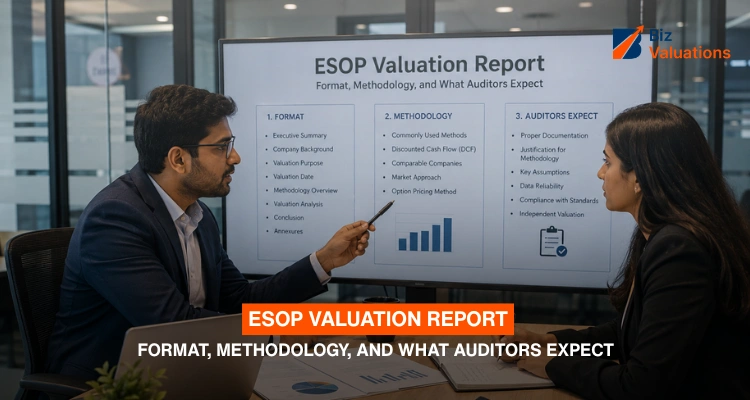
Report formats vary slightly by jurisdiction, company complexity, and the valuer's own methodology. However, high-quality reports consistently follow a structure that auditors and regulators recognize on sight.
1. Executive Summary
This opening section gives a fast overview: the purpose and date of the valuation, company identification, the concluded per-share FMV and total equity value, the methods used, and the applicable standards. It lets board members and auditors grasp the outcome before reading further.
2.Company Overview
A detailed narrative covering the business model, history, products or services, revenue sources, market position, and ownership structure. Auditors check this section closely to confirm it aligns with the company's financial statements. Key risks, customer concentration, and intellectual property should also be addressed here.
3.Purpose and Scope of Valuation
This section states the intended use clearly, whether that is an ESOP grant, periodic financial reporting, tax planning, or a regulatory filing. It also lists the information sources reviewed, documents relied upon, management interviews conducted, and any limitations acknowledged.
4.Economic and Industry Analysis
This covers macroeconomic conditions, sector-specific trends, growth drivers, and competitive forces. This context justifies the growth assumptions and risk adjustments used later in the projections, often referencing industry benchmarks and economic forecasts.
5.Financial Analysis
This core section reviews 3 to 5 years of historical performance along with the current financial position. It typically includes:
- Revenue trends and diversification
- EBITDA and margin analysis
- Cash flow generation and working capital management
- Balance sheet strength, including assets, liabilities, and capital structure
- Key financial ratios and peer comparisons
- Normalization adjustments for non-recurring or owner-specific expenses
6.Valuation Methodology
This is the most closely scrutinized part of the report. It explains why specific approaches were chosen, why alternatives were rejected, the detailed calculations and inputs used, and how multiple methods were weighted if more than one was applied.
7.Key Assumptions
This section lists and supports every major assumption, including revenue growth rates, margin trajectories, the discount rate (such as WACC), terminal growth, inflation, and capital expenditure needs. Auditors test whether these rest on historical evidence and industry data rather than optimistic guesswork.
8.Valuation Conclusion
This presents the final FMV, per-share value, total equity value, and the effective date. If multiple methods were used, this section should reconcile the results to add credibility to the final figure.
9.Limitations, Disclaimers, and Qualifications
Standard language here addresses reliance on the information provided, confidentiality, intended users, and external factors beyond the valuer's control. This protects the integrity of the report while maintaining professional standards.
Additional sections may include sensitivity analysis, scenario testing, and appendices with detailed models, source data, and the valuer's credentials.
Common ESOP Valuation Methodologies
Valuers select and often combine approaches based on the company's stage, data availability, and the purpose of the valuation. Three primary frameworks, Income, Market, and Asset, form the foundation, along with specialized techniques for complex capital structures.
1.Discounted Cash Flow (DCF) Method
This income approach remains the cornerstone for growth-oriented and private companies. It calculates enterprise value as the present value of projected free cash flows, discounted at a rate that reflects business and market risk (usually WACC), plus a terminal value.
- Strengths: Forward-looking, captures growth potential, and is widely accepted by regulators and auditors.
- Challenges: Highly sensitive to assumptions about growth, margins, and discount rates.
- Best suited for: Profitable or near-profitable companies with reliable projections.
2.Market Multiple Method
This market approach applies valuation multiples from comparable publicly traded companies (such as EV/EBITDA or Price/Earnings) or recent M&A transactions, adjusted for differences in size, growth, and risk.
- Strengths: Reflects real market pricing and is relatively straightforward to apply.
- Challenges: Finding truly comparable companies and adjusting for a lack of marketability in private shares.
- Best suited for: Companies in sectors with active public peers or transaction data.
3.Net Asset Value (NAV) or Asset-Based Method
This method values the business by adjusting assets and liabilities to their fair market values. It is often used as a floor value or a supplementary approach for asset-heavy or holding companies. Under Rule 11UA, this is also one of the two prescribed methods for tax-purpose FMV, alongside DCF.
4.Option Pricing Models: Black-Scholes and Binomial
For companies with complex capital structures, including multiple share classes or preferred stock with liquidation preferences, an Option Pricing Model (OPM) treats each equity class as a call option on the overall enterprise value. This is also the model required under Ind AS 102 to price the ESOP itself, not just the underlying share.
- Black-Scholes Model uses five inputs: the share price (from the equity valuation), the exercise price, time to expiration, expected volatility, and the risk-free rate, usually linked to Indian government bond yields.
- Binomial Model builds a tree of potential future stock prices at each stage until expiry, which makes it useful for options with unusual vesting or exercise conditions.
- PWERM (Probability-Weighted Expected Return Method) and hybrid approaches are also common for venture-backed startups with multiple funding scenarios.
Valuers frequently reconcile results from more than one method, applying professional judgement to reach a final conclusion. The report must document this reconciliation clearly for auditors to follow.
Factors Affecting ESOP Valuation
Valuation outcomes depend on several interdependent variables:
- Historical and projected financial performance
- Industry dynamics and competitive positioning
- Management quality and depth
- Customer and supplier concentration risk
- Intellectual property, brand value, and other intangible assets
- Capital structure and funding history
- Macroeconomic conditions and the regulatory environment
- Growth opportunities and execution risk
A clear understanding of these factors allows the valuer to apply the right adjustments and risk premiums for your specific business.
What Auditors Expect in an ESOP Valuation Report
Auditors approach every valuation report with professional skepticism, focused on whether the FMV determination supports accurate financial statement presentation. Their review centres on independence, reasonableness, and supportability.
Auditors typically expect:
- Independent Expertise. The valuer must be a qualified, unbiased professional with relevant credentials and ESOP-specific experience.
- Comprehensive Documentation. Access to the underlying models, source data, management representations, and industry research used.
- Supported Assumptions. Every major input backed by evidence, whether that is historical trends, peer data, or documented management rationale. Sensitivity analysis showing the impact of changing assumptions is highly valued.
- Methodological Appropriateness. A clear match between the chosen technique and the company's actual stage and profile.
- Consistency. Reasonable continuity with prior valuations, unless a genuine business change justifies a shift in approach.
- Regulatory Alignment. Compliance with the applicable accounting standards, valuation guidelines, and tax rules.
- Transparency on Risks. Open discussion of uncertainties and any potential bias in the assumptions used.
Auditors may request a walkthrough of key calculations, test past projections against actual results, and review any adjustments made for non-operating items or control discounts. Organized working papers and proactive communication make this process far smoother
Common Mistakes in ESOP Valuation Reports
Even experienced teams fall into pitfalls that trigger auditor questions or regulatory pushback:
- Relying on stale financial data or overly optimistic projections
- Insufficient support for key assumptions or discount rates
- Poor selection or adjustment of comparable companies
- Inadequate documentation of methodology or due diligence steps
- Mathematical inconsistencies or missing reconciliations between methods
- Failing to properly address complex capital structures
- Overlooking marketability or minority interest discounts where relevant
- Skipping sensitivity or scenario analysis entirely
Avoiding these mistakes requires disciplined preparation and early collaboration with an experienced valuation team.
Best Practices for Preparing an ESOP Valuation Report
To produce an audit-ready, credible report, companies should:
- Maintain clean, timely financial records and a robust, cross-functional forecasting process
- Engage independent valuers early and provide a complete information packet upfront
- Document every assumption thoroughly and check it regularly against actual performance
- Include sensitivity tables and multiple scenarios in the report
- Maintain methodological consistency over time, with clear explanations for any changes
- Organize supporting files for quick auditor access
- Review the draft report internally, and with the valuer, before finalization
- Stay current on evolving accounting standards and market conditions
Technology tools for cap table management and financial modelling can meaningfully improve both efficiency and accuracy across this process.
ESOP Valuation at Grant, Vesting, and Exercise: When Is It Required?
- At Grant Date: A mandatory IBBI Registered Valuer report is required under Section 62(1)(b) to set the equity fair value. This same figure feeds the Ind AS 102 option pricing model and the exercise price itself.
- At Vesting Date: No fresh valuation is legally required under the Companies Act, but auditors frequently request an updated figure if there has been a material change in the business.
- At Exercise Date: The fair market value at this point determines the perquisite tax the employee owes, calculated as the difference between FMV and the exercise price. This is where Merchant Banker or CA certification under Rule 11UA becomes relevant.
- For DPIIT-Recognized Startups: A special provision under Section 192(2C) of the Income Tax Act allows a 5-year deferral on perquisite tax payment, though the underlying valuation obligation remains unchanged.
- For Cross-Border Grants: Every allotment of shares to a non-resident employee on exercise requires a fresh FEMA-compliant valuation and an RBI filing through the company's authorized dealer bank.
How Often Should ESOP Valuation Be Performed?
Frequency depends on regulatory requirements, company stage, and specific trigger events. Many accounting rules call for annual valuations, particularly for financial reporting purposes. Additional valuations become necessary before new grants, significant transactions such as fundraising or M&A, material business changes, or IPO preparation.
Interim updates may be sufficient during stable periods, but proactive monitoring helps you avoid a last-minute rush before an audit or filing deadline.
Conclusion
A thoughtfully prepared ESOP valuation report is far more than a compliance checkbox. It reflects a company's commitment to transparency, sound governance, and sustainable growth. By following a structured format, applying suitable methodologies, grounding every assumption in evidence, and anticipating auditor priorities, your organization can navigate the complexities of equity compensation with confidence.
Whether you are a startup issuing your first ESOP grants or an established firm managing a mature plan, investing in a professional valuation process pays off through reduced risk, stronger stakeholder trust, and greater strategic clarity. As ESOPs continue to grow as a core part of Indian compensation strategy, getting the valuation discipline right remains a genuine competitive advantage.
Biz Valuations brings 15+ years of expertise, 3,500+ certified valuations, and dual IBBI Registered Valuer and SEBI Category I Merchant Banker registration to every ESOP engagement, allowing us to handle your accounting, tax, and regulatory valuation needs under one roof, with a 7 to 10 working day turnaround.
Frequently Asked Questions (FAQs)

Mr. Saurobh Barick
Registered Valuer (IBBI) & Valuation Expert
DCF & Fair Market Value Valuations | FEMA, Income Tax & Companies Act | 409A Valuation | M&A, Fundraising valuation | Cross-Border & Startup/Business Valuation | SME IPO AdvisorySaurobh Barick is a Registered Valuer with the Insolvency and Bankruptcy Board of India (IBBI) and a finance professional with over 15 years of experience in valuation and financial advisory services.