ESOP Pool Size: How to Decide and What It Means for Valuation
 Saurobh Barick
on
Saurobh Barick
on
Attracting top talent is one of the hardest challenges for any startup founder. Cash alone does not close the gap, especially when you are competing with large corporations offering higher salaries and bigger perks.
That is where an Employee Stock Ownership Plan (ESOP) pool becomes a gamechanger.
An ESOP pool gives employees a real stake in the company's future. It turns your best people into genuine partners, not just payroll entries. But getting the pool size right is harder than most founders expect.
Set it too small and you will struggle to hire or retain key people. Set it too large and you risk diluting yourself and early investors more than necessary. The ESOP pool size decision ripples through your hiring plans, investor negotiations, cap table structure, and even your company's valuation at every funding round.
This guide breaks down everything you need to know: what an ESOP pool is, how to size it correctly, how it interacts with valuation and dilution, common mistakes to avoid, and what Indian regulations require. Whether you are a first-time founder or a growth-stage CEO refining your equity strategy, this guide gives you actionable clarity.
Biz Valuations has helped hundreds of startups and private companies across India structure ESOP pools, obtain compliant valuations, and navigate regulatory requirements. With 3,500+ certified valuations across 35+ industries and 15+ years of expertise, we bring both technical depth and practical experience to every engagement.
Key Takeaways
- An ESOP pool typically represents 10 to 20% of a company's fully diluted equity, with early-stage startups usually starting at 10 to 15%.
- Pool size must be driven by your actual hiring roadmap, not an arbitrary number.
- The ESOP pool is almost always created pre-money, which means founders bear most of the dilution, not investors.
- Under Indian law, ESOP valuations must be performed by an IBBI Registered Valuer (for Companies Act compliance) and by a SEBI Category I Merchant Banker (for listed companies and tax purposes at exercise).
- A stale valuation used to set exercise prices can create income tax exposure for your employees.
- Regular reviews, ideally before every major funding round, are essential to keeping the pool healthy.
What Is an ESOP Pool?
An ESOP pool, also known as an employee option pool or equity incentive pool, is a portion of your company's equity set aside specifically for current and future employees. These shares are typically distributed as stock options, Restricted Stock Units (RSUs), or similar equity instruments.
Think of it as a talent budget in equity form. Instead of offering cash bonuses or inflated salaries, you offer ownership that vests over time. Employees earn the right to buy shares at a fixed strike price, usually the fair market value at the time of the grant. As the company grows, those options can become enormously valuable.
Key purposes of an ESOP pool include:
- Attracting talent: Especially in fields like tech, AI, fintech, and SaaS where candidates expect equity upside.
- Retaining key players: Vesting schedules (commonly four years with a one-year cliff) encourage long-term commitment.
- Aligning incentives: Employees start thinking and acting like owners when their wealth is tied to the company's success.
- Conserving cash: Critical for bootstrapped or early-stage companies managing a limited runway.
- Building culture: Shared ownership fosters a sense of purpose and long-term investment in the company's mission.
In practice, the pool sits on your cap table as authorized but unissued shares. Proper management means tracking utilization, handling forfeitures when employees leave before full vesting, and refreshing the pool as the company grows.
Why Startups Use ESOP Pools
Startups rarely have the cash reserves to match corporate salaries. ESOPs bridge that gap effectively by offering something larger: upside potential.
Real advantages go well beyond the obvious:
1. Talent magnet in competitive markets: Top engineers, sales leaders, and product executives often choose startups specifically for equity. In India, companies like Swiggy and others have created millionaire employees through liquidity events and buyback programs.
2. Retention power: Vesting ties people to milestones. A four-year schedule with annual or quarterly vesting has become the Indian startup standard.
3. Ownership mindset: Employees who own equity write better code, spend more carefully, and generate more innovative ideas.
4. Cash preservation: Every rupee saved on salary extends runway, which is critical during uncertain funding cycles.
5. Investor-friendly signal: A well-sized ESOP pool shows investors you have thought ahead about scaling the team responsibly.
Understanding ESOP Pool Size
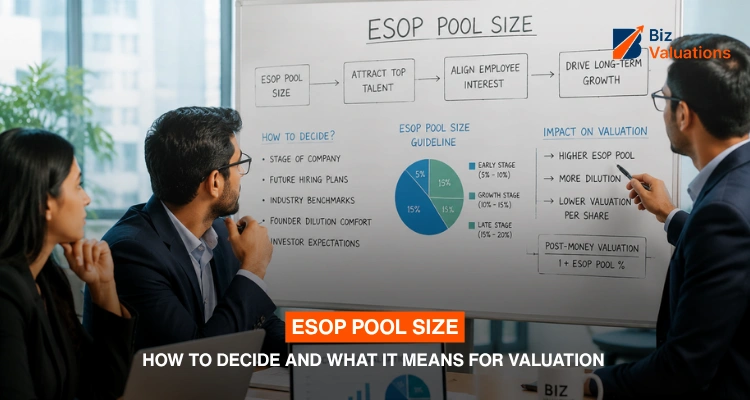
The ESOP pool size is the percentage of total company equity (on a fully diluted basis) reserved for employees.
Simple Example:
- Total shares outstanding: 1,000,000
- ESOP pool: 150,000 shares
- Pool size: 15%
This percentage is dynamic. It changes with new share issuances, funding rounds, and grants. Investors always look at it on a fully diluted basis, which includes all options, warrants, and convertible instruments.
Pool sizes are not one-size-fits-all. They depend heavily on the company's stage, industry, geography, and specific hiring needs. In the US, pools tend to be more generous, often growing to 15 to 20% or more. In India, pools often start smaller but are expanding as ESOP culture matures and successful exits multiply.
Typical ESOP Pool Sizes by Company Stage
Data from sources like Carta, Index Ventures, and Indian startup benchmarks show clear patterns: Company Stage Typical ESOP Pool Size Key Focus
| Company Stage | Typical ESOP Pool Size | Key Focus |
|---|---|---|
| Pre-Seed / Seed | 10% to 15% (up to 20% for talent-heavy sectors) | First 10 to 25 critical hires |
| Series A | 10% to 15% post-round | Top-up to sustain hiring until Series B |
| Series B and Growth | 10% to 20% | Senior leadership, refresh grants, international expansion |
| Later Stage / Pre-IPO | 5% to 10% or lower | Performance incentives, executive retention |
These are benchmarks, not rigid rules. A deep-tech AI startup competing for specialized talent may need a larger pool than a consumer app with easier hiring. Always validate your pool size against your actual hiring plan.
Factors That Influence ESOP Pool Size
Several practical factors should drive your decision on pool size:
- Hiring Roadmap: Map out the next 18 to 24 months. List every role, expected hire date, and typical grant size. C-level or VP hires might receive 0.5 to 2%, senior engineers 0.2 to 0.5%, and junior hires 0.05 to 0.2%. Build in a buffer for promotions and unexpected opportunities.
- Industry and Location: Tech, biotech, and fintech startups demand higher pools. Competitive markets such as Bangalore and Mumbai require more equity to attract talent away from high-paying alternatives.
- Growth Trajectory: Hyper-growth companies scaling teams rapidly need bigger reserves. Slower, profitable growth allows smaller pools.
- Cash Compensation Strategy: Lower base salaries require richer equity offers, which increases pool needs proportionally.
- Investor Preferences: VCs evaluate whether your pool is large enough to support the growth story in your pitch deck. A pool that is too small signals poor planning.
- Regulatory and Tax Environment: In India, DPIIT-recognized startups benefit from tax deferral on ESOPs under Section 80-IAC and Section 192(2C) of the Income Tax Act, currently allowing a 48-month deferral (extended to 60 months under the Income Tax Act 2025 from April 2026). US 409A compliance requirements add additional considerations for cross-border structures.
How to Calculate the Right ESOP Pool Size
Skip arbitrary percentages. Use a bottom-up plus top-down approach.
Step 1: Bottom-Up Hiring Forecast
Build a detailed spreadsheet listing every planned hire:
| Role | Expected Hire | Grant % | Total |
|---|---|---|---|
| CTO | Month 3 | 1.5% to 2.5% | 2% |
| 3 Senior Engineers | Q1 to Q2 | 0.3% each | 0.9% |
| Sales VP | Month 6 | 1% | 1% |
| 5 Junior Hires | Q3 to Q4 | 0.1% each | 0.5% |
Sum up all grants, then add a 3 to 5% buffer for refreshes, promotions, and surprises. Aim for a pool large enough to last until your next funding round.
Step 2: Top-Down Benchmarking
Compare your results against peer companies using data from Carta, Qapita, or similar platforms. Adjust for your specific sector and geography.
Step 3: Model Dilution Scenarios
Use cap table tools to simulate the pre-money and post-money impact. Understand exactly how each scenario affects founder, investor, and employee ownership.
Step 4: Stress Test and Align
Run multiple scenarios. What happens if hiring accelerates? What if you miss targets? Discuss early with your legal advisor and potential investors before signing a term sheet.
Pro Tip: Tools like Carta, Pulley, or Qapita help model this dynamically. Many founders deeply regret not building a robust model in the early stages.
The Relationship Between ESOP Pools and Valuation
This is where things get nuanced, and where many founders lose equity unnecessarily.
Pre-Money vs. Post-Money:
- Pre-money: The company's value before new investment arrives.
- Post-money: Pre-money value plus the new capital invested.
The ESOP Shuffle Explained
Investors often insist the pool be expanded before the investment closes. This is called the "ESOP shuffle" or the "option pool shuffle."
Why it matters:
- It protects the investor from immediate post-investment dilution.
- Founders and existing shareholders bear most of the dilution cost.
- In a Rs 10 crore pre-money valuation scenario, the difference between a pre-money and post-money pool structure can translate to Rs 30 to 80 lakhs of economic value for founders.
Numerical Example:
- Pre-money valuation: Rs 10 crore
- Investment: Rs 2.5 crore (Post-money: Rs 12.5 crore)
- Desired post-money pool: 10%
If the pool is created pre-money, founders issue more shares before investment closes. Founders dilute first, then dilute again when the investment comes in. Negotiate hard here. Your hiring plan is the strongest leverage you have to justify a smaller pool size.
ESOP Valuation vs. Fundraising Valuation: A Critical Distinction
Many founders confuse these two types of valuations, but they serve very different purposes.
A fundraising valuation determines the price an investor pays for preferred shares, which carry special rights such as liquidation preferences and anti-dilution protections. An ESOP valuation, on the other hand, determines the fair market value (FMV) of ordinary equity shares for the purpose of pricing stock options.
The FMV per ordinary equity share used for ESOP purposes is typically lower than the price paid by investors in the most recent funding round. This reflects the different rights attached to ordinary shares versus investor-preferred shares.
ESOP Valuation in India: What the Law Requires
This is a section many startup blogs overlook, but it is critical for compliance in India.
For Private Companies (Companies Act 2013, Section 62(1)(b)):
The fair market value of shares on the grant date must be determined by an IBBI Registered Valuer. The valuation must be as of the grant date. A report prepared months earlier cannot simply be re-dated. For companies granting options in multiple batches across the year, a fresh valuation report is required at each grant date, or the most recent report must be updated for any material changes in the business.
Using a stale equity valuation to set exercise prices creates income tax exposure for your employees if the actual FMV has increased since the report date.
For Listed Companies:
SEBI's Share-Based Employee Benefits Regulations require certification by a SEBI Category I Merchant Banker, not just an IBBI Registered Valuer.
For Accounting Purposes (Ind-AS 102):
The share-based payment expense recognized in the Profit and Loss account must be supported by a valuation from an IBBI Registered Valuer using standard option pricing models such as Black-Scholes, Binomial, or Monte Carlo.
For Tax Purposes at Exercise:
When employees exercise their vested options, the perquisite value (difference between FMV on exercise date and exercise price) is taxable as salary income. This computation requires a valuation by a SEBI Registered Merchant Banker.
Biz Valuations holds both the IBBI Registered Valuer credential and the SEBI Category I Merchant Banker registration. This means your startup can handle both the grant date valuation and the exercise date tax certification through a single trusted partner, rather than engaging multiple specialists.
Founder Dilution and ESOP Pools
Dilution is inevitable. But it is manageable if you plan ahead.
Every new share issuance reduces percentage ownership, even when absolute value rises as the company grows.
Classic Example:
Founders own 1,000,000 shares (100%). A 15% ESOP pool requires issuing approximately 176,471 new shares. Total shares become approximately 1,176,471. Founders now own approximately 85%.
Over multiple funding rounds, this compounds. Early employees also dilute but can still build significant wealth if the company succeeds and reaches an exit event.
Why Investors Care About ESOP Pool Size
Investors look for several things when evaluating your ESOP pool:
- Confidence that you can hire key people without triggering constant future dilution events.
- A pool sized for realistic, documented hiring needs and not inflated optimism.
- Protection through pre-money top-ups that shield their ownership percentage.
- Clear alignment between the pool size and the growth plan in the pitch deck.
A thoughtful, well-modeled pool signals management maturity. An oversized pool with no hiring plan to justify it raises serious red flags during due diligence.
Risks of an ESOP Pool That Is Too Large or Too Small
| Pool Too Large | Pool Too Small |
|---|---|
| Excessive founder dilution in early rounds | Hiring bottlenecks and talent loss to competitors |
| "Dead" equity sitting unused, signaling over-optimism | Repeated top-ups causing surprise dilution events |
| Harder term sheet negotiations in future rounds | Investor pushback during funding discussions |
| Unnecessary administrative overhead | Demotivated team due to limited equity incentives |
Balance is key. Regular reviews prevent both extremes.
Best Practices for Structuring an ESOP Pool
- Base decisions on data, not gut feel. Use hiring forecasts and industry benchmarks together.
- Review annually. Reassess before every major funding round or at least once a year.
- Benchmark grants by role. Refer to platforms like Qapita, AngelList, or local market reports for role-specific ranges in India.
- Plan for multiple rounds. Model dilution over three to five years, not just the next raise.
- Seek expert help early. Legal counsel, cap table specialists, and an experienced valuation partner are worth the cost.
- Communicate transparently. Educate employees on how equity works, what dilution means, and what scenarios could make their options valuable.
ESOP Pool Management Strategies
Good management keeps the pool healthy and compliant over time:
- Track utilization carefully. Know exactly how much of the pool has been granted versus what remains available.
- Reclaim forfeitures. Unvested shares from departing employees return to the pool and can be re-granted.
- Refresh strategically. Top up the pool as needed, ideally tied to major milestones or funding events.
- Align grants with performance. Larger grants should reflect genuine impact and contribution.
- Plan for liquidity events. In India, structured ESOP buybacks have created significant wealth in companies like Swiggy, Zepto, and others. Plan for secondary sales or an IPO path from the early stages.
- Keep valuations current. Update your ESOP valuation at least annually or whenever a significant event such as a funding round occurs. Stale valuations create audit problems and tax exposure.
The Future of ESOPs
ESOPs are evolving rapidly, both globally and in India.
More inclusive participation is growing beyond senior executives to engineers, designers, and even early customer success teams. In India, successful ESOP buybacks and liquidity events are accelerating mainstream adoption. DPIIT-recognized startups now have clearer tax frameworks with extended deferral periods under the Income Tax Act 2025.
AI-powered tools for cap table modeling and grant management are simplifying administration. Tokenized equity and digital securities may further transform how equity is tracked and transferred in the next decade.
Expect larger ESOP pools in talent-intensive sectors, more emphasis on tax-efficient structures, and stronger demand for employee education around equity mechanics and valuation.
Conclusion
Getting your ESOP pool size right is not just an HR exercise. It is one of the most consequential strategic and financial decisions you will make as a founder.
Done well, the ESOP pool fuels growth, aligns your team's interests with the company's long-term success, and creates meaningful shared wealth. Done poorly, it leads to dilution headaches, hiring struggles, investor friction, and compliance problems.
Build your pool from a real hiring plan. Model dilution scenarios before signing any term sheet. Get a compliant, defensible ESOP valuation from a qualified IBBI Registered Valuer at every grant date. Review regularly and communicate honestly with your team.
Biz Valuations supports founders, CFOs, and finance teams across India with IBBI-certified ESOP valuations, Rule 11UA compliance, Ind-AS 102 reporting, and cap table advisory. With 3,500+ certified valuations delivered across 35+ industries and a 7 to 10 working day turnaround, we are the independent valuation partner built for India's startup and corporate ecosystem.
Frequently Asked Questions (FAQs)

Mr. Saurobh Barick
Registered Valuer (IBBI) & Valuation Expert
DCF & Fair Market Value Valuations | FEMA, Income Tax & Companies Act | 409A Valuation | M&A, Fundraising valuation | Cross-Border & Startup/Business Valuation | SME IPO AdvisorySaurobh Barick is a Registered Valuer with the Insolvency and Bankruptcy Board of India (IBBI) and a finance professional with over 15 years of experience in valuation and financial advisory services.