
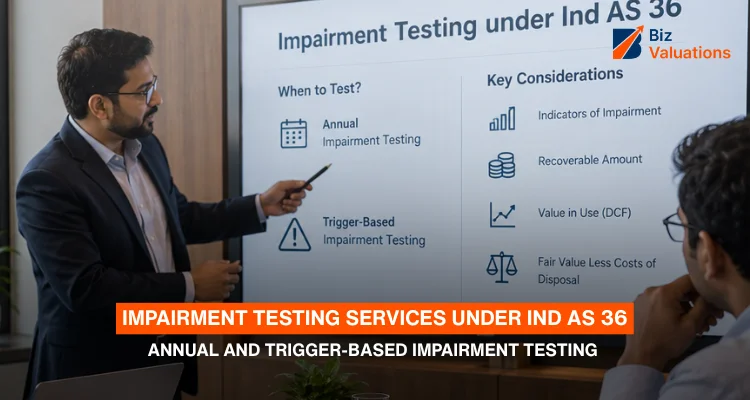
Impairment Testing Services Under Ind AS 36: Annual and Trigger-Based Impairment Testing
 Saurobh Barick
on
Introduction
Impairment testing under Ind AS 36 checks one thing. Is an asset carried in your books at more than it is really worth? If the carrying amount is higher than the recoverable amount, you must write the asset down. Recoverable amount is the higher of Value in Use and Fair Value Less Costs of Disposal.
Many finance teams still treat this as a year-end tick-box job. It is not. One impairment call can reset the book value of goodwill, cut reported profit, shrink net worth, and change how lenders and auditors read your accounts.
Ind AS 36 asks every entity to check, at each reporting date, for any sign of impairment. If a sign is there, you must work out the recoverable amount. Some assets must be tested each year even with no sign at all.
Three groups fall in that yearly bucket. Goodwill from a business combination. Intangible assets with indefinite useful lives. Intangible assets not yet ready for use.
For Ind AS reporters, this calls for sound models, assumptions you can defend, and a clean file. That is what expert impairment testing services under Ind AS 36 are built to give you.
Biz Valuations handles both annual and trigger-based impairment work. A job usually covers cash-generating unit (CGU) identification, recoverable amount analysis using Value in Use (VIU) and Fair Value Less Costs of Disposal (FVLCD), goodwill impairment testing, and the models your auditors will want to see.
Key Takeaways
- An asset is impaired when its carrying amount tops its recoverable amount, which is the higher of Value in Use and Fair Value Less Costs of Disposal.
- Goodwill, indefinite-life intangibles, and intangibles not yet in use are tested every year, with or without warning signs.
- A trigger-based test applies to any asset or CGU as soon as an internal or external sign appears.
- A CGU is the smallest group of assets that earns cash largely on its own.
- Goodwill is never tested alone. It is pushed down to the CGUs that gain from deal synergies, and a loss hits that goodwill first.
- A goodwill write-down can never be reversed. Other write-downs sometimes can.
- Discount rates, terminal growth, and forecast quality shape the answer far more than the maths does.
- NFRA has named impairment of non-financial assets a high-risk audit area in India.
- Early help from a valuer makes for a much smoother audit than a last-minute rush.
What Is Impairment Testing Under Ind AS 36?
Impairment testing checks whether the carrying amount of an asset or CGU sits above its recoverable amount. Ind AS 36 sets recoverable amount as the higher of:
- Fair Value Less Costs of Disposal (FVLCD), and
- Value in Use (VIU).
Where carrying amount tops recoverable amount, you book an impairment loss. The detailed rules in the Standard then kick in.
Here is a worked case. A CGU carries assets of Rs. 150 crore. Its FVLCD is Rs. 125 crore. Its VIU is Rs. 138 crore. Recoverable amount is Rs. 138 crore, the higher of the two. The impairment loss is Rs. 12 crore.
The maths is easy. The judgement is not.
Sales forecasts, margins, capital spend, working capital, terminal growth rates, discount rates, market mood, and the way you draw the CGU all move the answer. Change one input and the number shifts with it.
Ind AS 36 also accepts a plain fact of business life. Single assets rarely earn cash on their own. Where that is true, you test recoverable amount at the CGU level instead.
What Is the Scope of Ind AS 36?
Ind AS 36 does not cover every asset on the balance sheet. Knowing the line saves wasted work.
Usually inside scope:
- Property, plant and equipment
- Right-of-use assets
- Intangible assets, goodwill included
- Stakes in subsidiaries, associates and joint ventures
- Corporate assets such as a head office or shared IT
Outside scope, as other standards rule them:
- Inventories, under Ind AS 2
- Financial assets, under Ind AS 109
- Assets held for sale, under Ind AS 105
- Deferred tax assets, under Ind AS 12
- Employee benefit assets, under Ind AS 19
- Investment property at fair value, under Ind AS 40
- Biological assets at fair value less costs to sell, under Ind AS 41
Ind AS 36 is the Indian twin of IAS 36 and took over from AS 28. That shift matters, as impairment tests were rare under old Indian GAAP and are now routine.
What Is a Cash-Generating Unit (CGU) Under Ind AS 36?
A CGU is the smallest group of assets that earns cash inflows largely free of the inflows from other assets or groups. Getting the CGU right is the single biggest step in any Ind AS 36 job.
Picture a group with arms in consumer products, healthcare, technology, logistics and manufacturing. It will almost never test impairment at the top level. Fit CGUs may be whole businesses, divisions, subsidiaries, plants or product lines.
What sets the boundary? Two things. How the cash actually comes in, and how the board tracks each unit.
A simple test helps. If a unit could be sold on its own, and its cash does not lean on another unit, it is likely a CGU. A shared HR or IT team fails that test. Those are corporate assets, pushed down to CGUs rather than treated as CGUs.
A badly drawn CGU warps all that follows. Draw it too wide and a real loss hides inside a healthy sibling. Draw it too narrow and you may book a loss the facts do not support. The split must follow the business and the Standard, never ease.
Annual Impairment Testing Under Ind AS 36
Some assets must be tested each year whether or not a warning sign exists.
1. Goodwill acquired in a business combination
Goodwill is pushed down to the CGUs, or groups of CGUs, set to gain from the synergies of the deal. It is tested each year at that level.
2. Intangible assets with an indefinite useful life
Brands, trade marks, some licences and other IP that meet the indefinite-life test sit here.
3. Intangible assets not yet available for use
Assets still being built are also tested each year. Think tech projects, software, drug pipelines, patents and new product work. The reason is simple. Future gains from these assets are far from certain.
You may run the yearly test at any point in the cycle, as long as you keep the same date year on year. One exception applies. An intangible asset booked during the current period must be tested before that year ends.
Many firms run the test a few months before year-end. That leaves room to settle audit queries. Our Ind AS valuation services team supports both the early test date and the year-end date.
What Is Trigger-Based Impairment Testing Under Ind AS 36?
Beyond the yearly test, every entity must look for warning signs at each reporting date. When a sign exists, a formal test follows. These are known as trigger-based tests.
External signs include:
- A sharp fall in the market value of an asset
- Bad shifts in tech or market conditions
- A weaker economy
- Changes in law or rules
- Rising market interest rates or hurdle rates
- Market cap falling below the book value of net assets
- Shifts in the rival landscape
Internal signs include:
- Results well short of approved budgets
- Steady falls in sales or margins
- Loss of key customers
- A product being dropped
- A plant or unit shutting down
- Restructuring work
- Assets lying idle or under-used
- Operating losses and weak cash
- Bad changes in forecast results
- A board choice to sell or restructure a business
Take a real case. A subsidiary was bought for Rs. 500 crore. It then misses its plan, loses big customers, and starts burning cash. That pattern normally forces the board to check whether a warning sign exists, and if so, to work out the recoverable amount.
Hope is not a defence here. A belief that the unit will bounce back does not remove the duty to run the test.
Goodwill Impairment Testing Under Ind AS 36: How It Works
Goodwill impairment is one of the harder parts of Ind AS 36.
Goodwill arises when the price paid in a business combination tops the fair value of the net assets bought, as set out in Ind AS 103. Goodwill earns no cash on its own. So it is pushed down to the CGUs set to gain from the deal synergies.
The usual process runs like this:
- Pick the right CGU or group of CGUs.
- Push the goodwill down to it.
- Work out the carrying amount of the CGU, goodwill included.
- Work out the recoverable amount.
- Compare carrying amount with recoverable amount.
- Book any loss using the detailed split rules of Ind AS 36.
One limit is often missed. A CGU or group of CGUs that holds goodwill cannot be larger than an operating segment as set by Ind AS 108, before any grouping. That rule stops firms from burying a weak deal inside a whole-entity test.
A related question comes up a lot. Does a weak deal always mean a goodwill write-down? No. Goodwill is tested at the CGU level that gains from the synergies, not at the bought legal entity. If those synergies feed a wider CGU that is doing well, the test may show no loss.
Models here swing hard on long-term growth, margins and the discount rate. So the report must spell out the basis of each big assumption in plain words. Where goodwill came from a recent deal, auditors check it against the earlier purchase price allocation work first
How Is an Impairment Loss Recognised and Allocated Within a CGU?
Once a CGU is impaired, the loss must be split in a set order. The order is fixed. It is not a choice.
- Goodwill first. The loss cuts the goodwill held by that CGU, down to nil if needed.
- Other assets next. Any loss left over is spread across the other assets of the CGU pro rata, on their carrying amounts.
A floor applies in step two. No single asset may be cut below the highest of its own fair value less costs of disposal, its value in use, and zero.
A short case makes it clear. A CGU carries Rs. 1,140 crore, which holds goodwill of Rs. 300 crore. Its recoverable amount is Rs. 900 crore. The loss of Rs. 240 crore lands wholly on goodwill, cutting it to Rs. 60 crore. No other asset is touched.
The loss goes to profit or loss. The one exception is an asset held at a revalued amount, where it is treated as a revaluation fall.
How Is Value in Use (VIU) Calculated Under Ind AS 36?
Value in Use is the present value of the cash flows you expect from going on using an asset or CGU, plus the cash from its later sale.
A VIU model pulls together sales forecasts, running costs, EBITDA and EBIT, taxes, working capital, capital spend, free cash flows, terminal value and a fitting discount rate.
Cash flow forecasts must follow Ind AS 36. A few points matter in practice.
Forecasts should cover five years at most, unless a longer run can be backed up. They must rest on the latest budgets and plans the board has approved. They must leave out cash from future restructuring you have not yet committed to, and from lifting asset output past its current state.
Forecasts that look far rosier than history, or than last year's approved budget, draw an instant challenge. You need hard proof. That proof may be new contracts, added capacity, price changes, cost-cutting plans, product launches, a market upturn, new approvals or wider reach.
Never drop an assumption into a model with no reason on file. Our DCF valuation services team builds these models with an assumption log an auditor can follow line by line.
What Is Fair Value Less Costs of Disposal (FVLCD)?
FVLCD is what you could get from an orderly sale of the asset or CGU between market players, less the cost of selling it.
Based on the data you have, methods may include market multiples, peer company or deal analysis, quoted prices, discounted cash flow, or asset-based routes. The best choice turns on the asset type, the quality of market data, and the facts of the case. In practice FVLCD leads where a live market exists for like businesses, while VIU leads where the asset is niche or built deep into the group.
Recoverable amount is the higher of FVLCD and VIU. You need not work out both. If one measure already tops carrying amount, the Standard lets you stop there.
Discount Rate, Terminal Growth and Sensitivity Analysis in Impairment Testing
The discount rate moves present values more than almost any other input. Valuers weigh risk-free rates, equity risk premiums, beta, cost of equity and debt, country and size premiums, firm-specific risk, capital mix, and the need to match pre-tax cash flows with a pre-tax rate.
That last point is worth a flag. Ind AS 36 wants a pre-tax rate for VIU, used on pre-tax cash flows. Many models are built post-tax and then switched over. Do that switch with care, and show your work, as auditors look hard at it.
The rate must mirror market risk and asset risk. Never work it backwards to reach a comfy answer.
Terminal growth counts just as much. Your terminal rate should not top the long-run growth rate for the products, sectors or country you work in. A rate above long-run GDP growth is hard to defend.
Sensitivity analysis closes the loop. Flex sales growth, margins, the discount rate, terminal growth, capital spend and working capital. That shows the board and the auditors how close a CGU sits to its tipping point. A CGU with 2% headroom is a very different risk from one with 60%.
Annual vs Trigger-Based Impairment Testing: What Is the Difference?
Annual testing is a must for goodwill, indefinite-life intangibles, and intangibles not yet in use. Warning signs do not matter. The test happens anyway.
Trigger-based testing works the other way. It arises only when a sign is there. It can hit both tangible and intangible assets at any point in the cycle.
The two are not swaps for each other. A firm may wrap up its yearly test in October and still face a fresh test in February if a big trigger event lands.
| Basis of Comparison | Annual Impairment Testing | Trigger-Based Impairment Testing |
|---|---|---|
| When required | Every financial year, no exceptions | Only when a warning sign exists |
| Warning sign needed | No | Yes |
| Assets covered | Goodwill, indefinite-life intangibles, intangibles not yet available for use | Any asset or CGU inside the scope of Ind AS 36 |
| Timing | The same chosen date each year | The reporting date when the sign is spotted |
| Typical driver | Compliance with Ind AS 36 and Ind AS 103 | Weak results, market shocks, rule changes |
| Frequency | Once a year, minimum | As often as triggers appear |
| Evidence base | Approved budgets and long-range plans | Budget variances, lost contracts, market data, a log of warning signs |
| Can both apply in one year? | Yes, the yearly test does not cancel the trigger duty | Yes, a trigger can land after the yearly test is done |
| Audit focus | Goodwill split, headroom, sensitivity notes | Whether the sign was spotted on time and tested properly |
Can an Impairment Loss Be Reversed Under Ind AS 36?
Yes, but only within firm limits.
For assets other than goodwill, you may reverse a past loss if the estimates behind recoverable amount have changed since that loss was booked. The change must come from a real shift in the facts, not from time passing or a sunnier forecast.
The reversal is capped. The new carrying amount cannot top what the carrying amount would have been, net of depreciation, had you never booked the loss.
Goodwill is treated apart. A goodwill write-down can never be reversed under Ind AS 36. Any later rise counts as internally built goodwill, which you cannot book.
What Must Companies Disclose Under Ind AS 36?
Notes are where many sound impairment tests lose marks. The Standard wants detail, not one bland line.
You are expected to show:
- The losses and reversals booked in the period, and the line items hit
- The events that led to the loss
- For each big CGU, the goodwill and indefinite-life intangibles pushed down to it
- Whether recoverable amount rests on VIU or FVLCD
- The key assumptions, and how the board set them
- The discount rate, the forecast span, and the terminal growth rate
- Sensitivity data where a likely change in one key input would push carrying amount past recoverable amount
That last point is the one most often skipped. If headroom is thin, the sensitivity note is not a choice.
Common Pitfalls in Ind AS 36 Impairment Testing
Treating the job as a plain discounted cash flow sum is the top error of all. The number is the output. The judgement is the work.
Recurring problems include:
- Board forecasts with no proof behind them
- CGUs drawn wrong, often far too wide
- Discount rates picked to dodge a loss
- No response to clear warning signs
- Skipping the yearly goodwill test
- Thin or missing sensitivity analysis
- Assumptions that clash with other reports from the same firm
- Post-tax rates used on pre-tax cash flows with no proper switch
- Goodwill tested at legal entity level, not the right CGU level
- Notes that fall short of what the Standard asks
Each of these raises audit risk. Several raise regulatory risk too
What Does NFRA Expect From Impairment Testing in India?
Scrutiny of impairment has stepped up sharply in India.
The National Financial Reporting Authority (NFRA) put out its Auditor-Audit Committee Interactions Series 4 on the audit of estimates under Ind AS 36 and SA 540. It lists the questions audit committees should put to their auditors. The list spans CGU identification, goodwill split, cash flow assumptions, discount rates and sensitivity notes.
NFRA has also named impairment of non-financial assets a focus area in its audit quality checks on large firms. In its first Financial Reporting Quality Review Report, NFRA noted that a company showed no proper proof, such as a valuation report, for its Ind AS 36 test on a unit that had stopped running. It also found no proof that the workings ever went to the audit committee or the board.
The lesson is clear. A sound impairment call now needs an outside valuation report, assumptions on file, and a trail showing the board reviewed the work.
Typical Contents of an Ind AS 36 Impairment Testing Report
A sound impairment report usually covers:
- Company background and what the business does
- Purpose of the valuation, being impairment testing under Ind AS 36
- Valuation or testing date
- The asset or CGU picked, and why
- Past financial analysis
- A review of board forecasts
- Method used, whether VIU, FVLCD or both
- How the discount rate was built, with proof
- Terminal value assumptions
- Sensitivity analysis
- The recoverable amount
- Carrying amount compared, and the final call
A clear file serves two readers. It helps the board defend the call inside the firm, and it gives auditors the proof they are bound to collect
When Should You Engage an Impairment Valuation Specialist?
Early help beats a last-minute scramble in the audit every time.
Firms that gain most from an early start are those with:
- Large goodwill on the books
- Several subsidiaries or bought businesses
- Big intangible assets
- Loss-making CGUs
- Tech or build-stage assets
- Long-term projects
- Overseas arms
- A sharp drop in market cap
- Live restructuring plans
- Complex models to build
An early start does three useful things. It flags data gaps while there is time to fill them. It lets you test assumptions before they harden into a filed number. And it settles CGU questions before the audit team raises them.
The cost of delay is rarely money alone. The audit timetable, the board meeting and the filing deadline all suffer.
About Saurobh Barick, Founder of Biz Valuations
Saurobh Barick is the founder of Biz Valuations and an IBBI Registered Valuer. He brings more than 15 years in valuation and financial advisory.
He holds an MBA in Finance and an LLB. He is also pursuing a PhD in Management on how SME IPOs perform in the Indian capital market. His background takes in board-level work with a Category-I Merchant Bank and a role in more than 60 SME IPOs.
He has personally run hundreds of valuation jobs across FEMA, Income Tax, Companies Act, mergers and acquisitions, share valuation and cross-border deals. That blend of rules, deals and modelling fits complex impairment work, where accounting rules meet business valuation.
Why Biz Valuations Is Regarded as a Leading Valuation Firm in India
The phrase "best valuation firm in India" is a matter of view. Clients weigh different things. Some hard facts do set Biz Valuations apart:
- IBBI Registered Valuer depth for statutory work under the Companies Act and linked rules.
- Association with a SEBI-registered Category-I Merchant Banker for FEMA, FDI, SEBI and cross-border work.
- A record of more than 3,500 certified valuation projects.
- Work across 35+ industries, from technology and SaaS to manufacturing, financial services, NBFCs, pharma, healthcare, consumer, infrastructure and energy.
- Full Ind AS and IFRS skills: impairment testing, purchase price allocation, fair value work, financial instrument valuation, ESOP valuation and expected credit loss models.
- A strong DCF and modelling practice spanning FCFF, FCFE, WACC, CAPM, terminal value, scenario work and risk tweaks.
- Deal and M&A valuation work that feeds straight into goodwill and intangible analysis after a buyout.
Biz Valuations works as an outside firm, focused on reports that hold up with auditors, regulators, investors and courts. Each report carries the records and sensitivity work that auditors routinely test.
Biz Valuations' Approach to Impairment Testing
A typical job moves through set stages:
- Learn the business model and past results
- Spot internal and external warning signs
- Draw CGUs in line with Ind AS 36
- Check carrying amounts
- Build VIU and FVLCD models as needed
- Set and back up the key assumptions
- Run sensitivity analysis
- Arrive at the recoverable amount
- Compare it with carrying amount
- Write up a clear file for board and auditor review
Sector factors are built in. Technology and SaaS work leans on repeat revenue, churn and the risk of going out of date. Manufacturing work turns on plant use, input prices and upkeep spend.
Pharma and healthcare jobs weigh the pipeline, patent life and new rules. Infrastructure and energy models look at tariffs, long contracts and build risk. Consumer firms hinge on brand strength, market share and margins. Where brands and customer ties carry real value, the work links straight to intangible asset valuation method.
How Do Auditors Evaluate Ind AS 36 Impairment Tests?
Auditors tend to probe the same list each year:
- Forecast accuracy against past results and approved budgets
- How the CGU was drawn, and why
- Discount rates and how they were built
- Terminal growth rates
- Sensitivity analysis and headroom
- The market data used
- Fit with other reports the firm has filed
- How goodwill was split across CGUs
- The overall quality of the file
A good model does more than print a number. It shows why each assumption is fair, in a form the audit file can absorb.
Conclusion: Getting Ind AS 36 Impairment Testing Right
Impairment testing under Ind AS 36 is a core part of reporting for any firm that carries goodwill, big intangible assets, or units exposed to shifting markets. The line between the yearly test and the trigger-based test must be kept clear, never blurred.
A sound test goes well past the sum. It needs the CGU drawn right, forecasts you can trust, assumptions you can back, a fitting discount rate, VIU and FVLCD work where relevant, sensitivity tests, a proper goodwill split, and a file that matches the Standard.
For firms closing annual accounts, folding in a recent buyout, restructuring, or reacting to a big event, early help from a seasoned valuer makes the process calmer and easier to defend. Biz Valuations brings together IBBI Registered Valuer credentials, a Category-I Merchant Banker tie-up, deep DCF modelling skill, and work across more than 35 industries and 3,500 projects. Led by founder Saurobh Barick, the firm backs CFOs, finance teams, auditors and boards with clear views on recoverable value.
When you need impairment testing services under Ind AS 36 in India, aim for a clear, supportable read on recoverable amount rather than just a number. That is the outcome Biz Valuations is built to deliver.
Frequently Asked Questions About Ind AS 36 Impairment Testing
Disclaimer: This article gives general information on Ind AS 36 impairment testing. It is not accounting, audit, tax or legal advice. Please seek guidance specific to your own engagement.

Mr. Saurobh Barick
Registered Valuer (IBBI) & Valuation Expert
DCF & Fair Market Value Valuations | FEMA, Income Tax & Companies Act | 409A Valuation | M&A, Fundraising valuation | Cross-Border & Startup/Business Valuation | SME IPO AdvisorySaurobh Barick is a Registered Valuer with the Insolvency and Bankruptcy Board of India (IBBI) and a finance professional with over 15 years of experience in valuation and financial advisory services.