Business Valuation Services in Noida: A Complete Guide for Companies, Startups and Investors
 Saurobh Barick
on

Introduction
Business valuation services in Noida help a company find the fair and defensible value of its shares, assets, or whole business. Founders, CFOs, and investors use that value for fundraising, share issues, ESOPs, mergers, tax filings, and foreign investment. For most regulated deals, an IBBI Registered Valuer must sign the report. This guide shows when you need a valuation, which method fits, what it costs, and how to pick the right valuer in Noida.
Noida is now one of North India's busiest business hubs. Software and technology firms sit in Sector 62 and Sector 63. Manufacturers, logistics players, fintech startups, and service firms work across Greater Noida and the wider Delhi NCR. The region has also gained fresh momentum. The Noida International Airport at Jewar opened in March 2026. New electronics and data centre projects are following. In such a fast-moving market, valuation is no longer a one-time task. It is a regular need for fundraising, deals, compliance, employee stock options, disputes, and planning.
A good valuation tells promoters, boards, and investors what a business is truly worth. A well-built report supports price talks. It meets the Companies Act and Income Tax needs. It satisfies FEMA conditions for foreign money. It also gives independent proof that can stand up to auditors and regulators.
Biz Valuations offers business valuation services with a dedicated office in Noida. The firm brings IBBI Registered Valuer expertise and a tie-up with a Category-I Merchant Banker. It also has deep experience across startups, private firms, and established businesses.
Key Takeaways
- A business valuation in Noida is needed for fundraising, share issues, FEMA deals, ESOPs, mergers, Ind AS reporting, and disputes.
- Only an IBBI Registered Valuer can sign reports for many Companies Act transactions, such as preferential allotment and private placement.
- The three core methods are the income approach (DCF), the market approach, and the asset-based approach. Most strong reports blend two or more.
- The purpose of the valuation decides the format, the signatory, and the rules that apply. One report may not fit every use.
- Revenue quality, profit, customer concentration, intellectual property, and management strength drive value the most.
- Complete documents speed up the work. Most standard assignments finish in about 7 to 10 working days once data is ready.
- Biz Valuations has delivered 3,500+ valuations across 35+ industries, with an office in Sector 168, Noida.
Why Business Valuation Matters in Noida
Noida's economy is built on high growth and steady domestic and foreign investment. Companies here sit at every stage of the business lifecycle. Many of them face moments that call for an independent valuation:
- Raising money from angel investors, venture capital funds, or private equity
- Issuing shares or convertible instruments
- Preferential allotment or private placement under the Companies Act
- Foreign direct investment, or share transfers that involve non-residents
- Employee stock option plans and sweat equity
- Mergers, demergers, acquisitions, or business transfers
- Financial reporting under Ind AS, including impairment testing and purchase price allocation
- Dispute resolution, family settlements, or shareholder exits
- Bank financing or internal strategic planning
In each case, the quality of the valuation shapes the result. A weak or poorly documented report can delay approvals. It can also create tax exposure and hurt your position in negotiations. A clear, sound valuation does the opposite. It gives management and stakeholders confidence.
There is a cost to getting it wrong. A report that a regulator or auditor rejects means lost weeks, repeat fees, and sometimes a stalled deal. Getting the valuation right the first time is the cheaper path.
What Is Business Valuation?
Business valuation is the process of estimating the economic value of a company, a business unit, or specific assets and securities. The valuer studies past financial results, future cash flow potential, market conditions, and data on similar firms. The valuer also looks at asset values, risk factors, and the exact purpose of the report.
No single method works for every case. The right approach depends on the type of business, the quality of data, and the legal or deal setting. Three approaches are in common use.
Income Approach (Discounted Cash Flow)
The valuer projects future free cash flows and discounts them to today's value using a suitable discount rate. This method works well for going-concern businesses with predictable or well-supported forecasts. Models often use FCFF, FCFE, WACC, and CAPM to build the discount rate and the terminal value.
Market Approach
Here, value comes from comparing the company with similar businesses that were sold or that trade on a stock exchange. The valuer applies multiples of revenue, EBITDA, or other metrics after making fair adjustments for size, growth, and risk.
Asset-Based Approach
This approach assesses the value of tangible and intangible assets. It suits asset-heavy firms, holding companies, and cases where the income approach is less reliable.
In practice, a strong valuation blends more than one method and reconciles the results. Sensitivity analysis matters too. It shows how growth rates, margins, or discount rates can move the final number.
| Approach | Best for | Main inputs | Common watch-out |
|---|---|---|---|
| Income (DCF) | Going-concern businesses with solid forecasts | Cash flow projections, WACC, terminal growth | Results swing with small assumption changes |
| Market | Firms with listed or transacted peers | Revenue and EBITDA multiples, deal data | Few true peers for niche or early-stage firms |
| Asset-based | Asset-heavy firms and holding companies | Net asset value, fair value of assets | May understate future earning power |
Common Valuation Requirements for Noida Businesses
Most valuations in Noida fall into a few groups. Knowing the group helps you pick the correct report from the start.
Fundraising and Startup Valuation
Noida and the wider NCR host many technology, SaaS, fintech, and consumer startups. Valuing a seed, Series A, or later round needs close study of unit economics, growth path, market size, and capital structure. Founders need a realistic pre-money value that balances dilution against investor hopes.
Stage matters here. Seed-stage firms are often judged on team, product, and early traction. Series B and later rounds lean on revenue, margins, and retention. Pre-IPO companies face deeper checks from merchant bankers and regulators. Startups with US investors or US-based staff may also need a 409A valuation for their stock options. See our guide to 409A valuation services for details. For early-stage work, our startup valuation services page explains the process in full.
Companies Act Valuation
Some transactions under the Companies Act, 2013 need a valuation by a registered valuer. These include preferential allotment, private placement, issue of shares for consideration other than cash, and certain restructuring deals. Section 247 and the related Valuation Rules set the framework. Our statutory valuation services cover these needs.
FEMA and Cross-Border Transactions
Many Noida companies receive foreign investment or hold overseas subsidiaries. Share issues or transfers that involve non-residents often need a valuation on an arm's-length basis. The valuer uses internationally accepted methods and gives the right certification. Our FEMA valuation services support FDI and ODI filings.
Income Tax Valuation
Rule 11UA of the Income Tax Rules prescribes methods to find the fair market value of unquoted shares in set situations. The new Income-tax Act, 2025 applies from 1 April 2026. Its Rules carry these valuation provisions forward under new numbering. Rule 57 is widely cited as the successor to Rule 11UA. Please confirm the exact rule reference with your tax adviser for each filing.
An incorrect valuation can lead to tax exposure under rules on share premium or transfer pricing. One more update is worth noting. The old angel tax on share premium was removed with effect from 1 April 2025 (assessment year 2025-26). Fair market value still matters for share transfers and other tax provisions, so valuation remains a compliance need.
ESOP and Sweat Equity Valuation
Technology and professional services firms in Noida often use ESOPs to attract and keep talent. Fair valuation of equity for option grants needs careful work. It covers Ind AS 102 accounting, tax rules, capital structure, preference rights, and expected exit paths. Our ESOP valuation compliance guide explains the steps.
Mergers, Acquisitions and Restructuring
Big deals call for independent valuation of each business. The valuer sets the swap ratio. Where needed, the valuer also handles purchase price allocation under Ind AS 103. Our PPA valuation services help here.
Ind AS and Financial Reporting
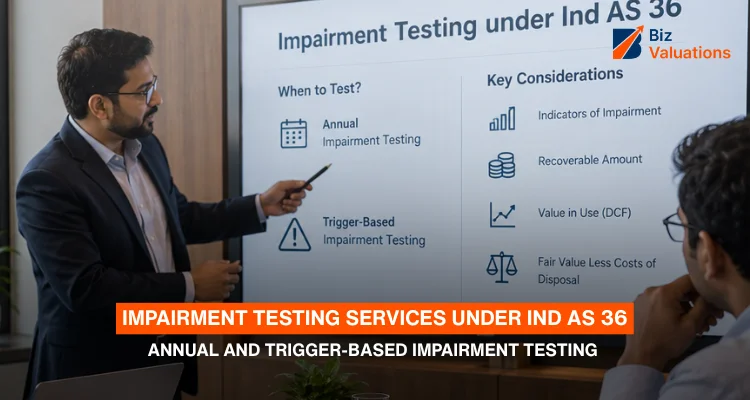
Companies that report under Ind AS may need valuations for several tasks. These include impairment testing of goodwill and intangibles, fair value measurement of financial instruments under Ind AS 113, and other reporting needs. See our Ind AS valuation services page.
Which Valuation Do You Need? A Quick Comparison
Use this table to match your situation with the right report and signatory.
| Situation | Governing framework | Typical valuer | Common method |
|---|---|---|---|
| Preferential allotment or private placement | Companies Act, 2013, Section 62 and 42 | IBBI Registered Valuer | DCF and market, reconciled |
| Share issue to a non-resident | FEMA and RBI pricing rules | SEBI Merchant Banker or eligible professional | DCF, internationally accepted methods |
| Unquoted share tax valuation | Income Tax Rules (Rule 11UA, now Rule 57) | Merchant Banker for DCF, accountant for net asset method | Prescribed formula or DCF |
| ESOP grants and sweat equity | Companies Act, SEBI rules, Ind AS 102 | Registered Valuer or Merchant Banker | Option pricing with DCF or market |
| Merger, demerger, or swap ratio | Companies Act, Sections 230 to 232 | IBBI Registered Valuer | DCF, market, and asset-based |
| Impairment and purchase price allocation | Ind AS 36, Ind AS 103, Ind AS 113 | Independent valuer | DCF and relief from royalty |
| US-linked option grants | IRC Section 409A | 409A specialist | Hybrid and option pricing |
Key Factors That Influence Business Value
Several factors usually drive valuation outcomes for firms in Noida and the wider NCR:
- Historical and projected revenue growth
- Profitability and cash flow generation
- Quality and predictability of earnings
- Customer concentration and retention
- Competitive position and barriers to entry
- Intellectual property and technology strength
- Management capability and organisational depth
- Capital structure and existing investor rights
- Industry outlook and macroeconomic conditions
- Regulatory and geographic risk
Weights shift by sector. For asset-light technology firms, recurring revenue, net revenue retention, and unit economics count the most. For manufacturing or infrastructure firms, capacity use, order book, and replacement cost often matter more.
Valuers also apply discounts and premiums. A discount for lack of marketability (DLOM) can apply to private shares that are hard to sell. A control premium may apply when a buyer gets management control. Hybrid methods and volatility benchmarking are common for startups with complex share classes.
The Role of an IBBI Registered Valuer
Since the Companies (Registered Valuers and Valuation) Rules, 2017, only IBBI Registered Valuers can issue valuation reports for many statutory purposes under the Companies Act. Reports from non-registered professionals are generally not accepted by the Registrar of Companies or other authorities for such deals. According to the Insolvency and Bankruptcy Board of India (IBBI), registered valuers work under a prescribed code of conduct and valuation standards.
An IBBI Registered Valuer brings independence, respect for set standards, and personal accountability. For Noida firms planning preferential allotments, private placements, or other regulated deals, hiring a registered valuer is not optional. It is a compliance requirement.
About Saurobh Barick, Founder of Biz Valuations
Saurobh Barick is the founder of Biz Valuations and an IBBI Registered Valuer. He has over 15 years of experience in valuation and financial advisory. He holds an MBA in Finance and an LLB. He is also pursuing a Ph.D. in Management, with a focus on the performance of SME IPOs in the Indian capital market.
His background includes board-level work with a Category-I Merchant Bank, where he handled more than 60 SME IPOs. He has personally completed hundreds of valuation assignments. These cover FEMA, Income Tax, Companies Act, mergers and acquisitions, share valuation, cross-border deals, 409A valuation, and purchase price allocation. This mix of finance, legal, and deal experience helps when a valuation must satisfy both business talks and regulators.
Why Biz Valuations Is a Strong Choice for Business Valuation in Noida
The label "best valuation firm in India" is subjective. It depends on what each client needs. Still, several clear factors make Biz Valuations a capable partner for firms in Noida and Delhi NCR:
- Local presence in Noida: The office at Nimbus The Golden Palms, Tower J001, Sector 168, Noida gives clients easy access across the NCR.
- IBBI Registered Valuer expertise: Registered valuers prepare reports for statutory purposes under the Companies Act.
- Category-I Merchant Banking tie-up: This supports FEMA, FDI, and related regulatory valuations.
- Track record: The firm has completed more than 3,500 certified valuation projects.
- Industry coverage: It has worked across 35-plus industries, including technology, manufacturing, financial services, healthcare, consumer businesses, and infrastructure.
- End-to-end services: These cover business valuation, startup valuation, ESOP valuation, FEMA and Income Tax valuations, Ind AS work (including impairment and PPA), intangible asset valuation, and M&A assignments.
- Strong modelling practice: DCF models use FCFF, FCFE, WACC, CAPM, terminal value, scenario analysis, and risk adjustments.
- Independence and documentation: Reports carry the clear support and analysis that auditors, regulators, and investors expect.
Biz Valuations is an independent valuation specialist. It does not treat valuation as a side activity of a general advisory firm. For Noida firms that need defensible, purpose-specific reports, that focus is a real advantage. Our business valuation services page lists the full range.
How Biz Valuations Approaches a Business Valuation Engagement
A typical engagement follows a clear process:
- Clarify the purpose of the valuation, such as fundraising, Companies Act, FEMA, Income Tax, ESOP, M&A, reporting, or internal planning.
- Understand the business model, industry, competitive position, and past performance.
- Collect and review financial statements, management accounts, forecasts, and key agreements.
- Choose suitable valuation methods based on the facts and the regulatory context.
- Build financial models, apply market multiples where relevant, and run sensitivity analysis.
- Review the capital structure, preference rights, and any convertible instruments.
- Reach enterprise value and equity value conclusions.
- Prepare a clear report that records the purpose, date, method, assumptions, analysis, and conclusion.
The goal is a report that helps management and satisfies the intended reader. That reader may be an investor, an auditor, the Registrar of Companies, or a tax authority.
How Long Does a Business Valuation Take in Noida?
Most standard assignments finish in about 7 to 10 working days after the full data set arrives. Complex cases take longer. Examples include multi-method DCF work, layered share classes, or legal cross-checks. Some industry guides quote four to six weeks for detailed DCF reports. It is wise to confirm the timeline at the start.
What Does a Business Valuation Cost in Noida?
Fees depend on the purpose, the complexity, and the report type. According to published industry guides, simple net asset reports may start in the tens of thousands of rupees. Standard DCF reports often run into a few lakhs, and complex deals can cost more. A fixed quote after a scoping call is the best way to avoid surprises.
Common Valuation Mistakes to Avoid
- Using one report for several purposes without checking the rules
- Relying on aggressive forecasts with no support
- Ignoring preference rights and convertible instruments in the cap table
- Hiring a valuer who is not registered when the law needs one
- Sharing late or incomplete data, which delays the report
Documents Typically Required
Clients are usually asked to share:
- Certificate of incorporation, Memorandum and Articles of Association
- Shareholding pattern and capitalisation table
- Shareholders' agreements and investment documents
- Audited financial statements for recent years and the latest management accounts
- Revenue and cost breakdowns, with customer data where relevant
- Business plan and financial projections
- Details of intellectual property, major contracts, and contingent liabilities
- Term sheets or draft deal documents, when they apply
Complete and well-organised information improves both report quality and turnaround time.
Conclusion
Business valuation is a practical tool for firms in Noida. It supports capital raising, compliance, deals, and strategic choices. The quality of the analysis and the credibility of the report both matter. Unsupported numbers or missing documents create needless risk.
Biz Valuations provides business valuation services with an office in Sector 168, Noida, and wide coverage across Delhi NCR. The firm brings IBBI Registered Valuer credentials, a Category-I Merchant Banking tie-up, and experience across 3,500+ projects and 35-plus industries. It meets the modelling and documentation standards that investors, auditors, and regulators expect. Founder Saurobh Barick adds more than 15 years of valuation and financial advisory experience across regulatory, deal, and reporting work.
Frequently Asked Questions: Business Valuation Services in Noida
Disclaimer: This article is for general information only. It is not legal, tax, or investment advice. Rules and rates change, so confirm current requirements with a qualified professional before acting.

Mr. Saurobh Barick
Registered Valuer (IBBI) & Valuation Expert
DCF & Fair Market Value Valuations | FEMA, Income Tax & Companies Act | 409A Valuation | M&A, Fundraising valuation | Cross-Border & Startup/Business Valuation | SME IPO AdvisorySaurobh Barick is a Registered Valuer with the Insolvency and Bankruptcy Board of India (IBBI) and a finance professional with over 15 years of experience in valuation and financial advisory services.