ESOP Glossary: Vesting, Cliff, Exercise Price, and 50+ Key Terms
 Saurobh Barick
on
Saurobh Barick
on

Introduction
Employee equity sounds straightforward until the first grant letter arrives. A startup tells a new hire: "You are receiving 20,000 stock options with a four-year vesting period, a one-year cliff, and an exercise price of $1.25 per share." Excitement follows. Then the questions start piling up.
What does vesting actually mean in practice? What happens at the cliff? Is the exercise price the same as the current value of the shares? What is the real difference between granted, vested, and exercised options? What occurs if the employee leaves? What is a 409A valuation and why does it matter? How do incentive stock options differ from nonqualified ones? What does fully diluted ownership actually represent? And the biggest question of all: how much is this ESOP really worth?
These questions matter because employee equity is never just a number printed on an offer letter. The economic value of an ESOP depends on the number of options granted, the vesting schedule, the exercise price, current fair market value, future company performance, dilution from later rounds, liquidation preferences sitting ahead of common stock, taxes, the timing of exercise, the ultimate exit value, and whether the employee can actually get liquidity. A grant of 100,000 options can eventually be worth millions. It can also end up worth nothing.
Understanding the language of equity compensation is therefore essential for founders, employees, investors, finance teams, startup advisers, and HR professionals. At Biz Valuations, with 3,500+ certified valuations across 35+ industries, we regularly see how a clear grasp of ESOP terminology helps stakeholders make better decisions during fundraising, compliance filings, and exit transactions.
This ESOP glossary explains more than 50 of the most important employee stock option and equity compensation terms in plain English. It also addresses the valuation concepts that sit behind them. The goal is practical clarity so readers can evaluate grants, ask better questions, and avoid common misunderstandings that cost people real money.
Key Takeaways
- An ESOP grants the right to purchase shares at a fixed price, but that right must be earned through vesting before it can be exercised.
- The cliff is an initial waiting period (commonly one year) during which no options vest at all.
- Exercise price (strike price) is fixed at the time of grant, while fair market value changes as the company grows.
- A 409A valuation determines the fair market value of common stock for private U.S. companies and directly affects option pricing.
- The latest funding round price does not automatically equal common share value because preferred shares carry liquidation preferences, conversion rights, and other protections.
- Valuation allocation methods like OPM, PWERM, and the backsolve method determine how total equity value is distributed across different share classes.
- DLOM (Discount for Lack of Marketability) reflects the reduced value of private company shares that cannot be freely traded.
- Options can become worthless if the company fails, the share price never exceeds the exercise price, or the option expires before exercise.
- Employees should always review the full grant agreement, vesting schedule, post-termination exercise window, and capital structure before making exercise decisions.
What Is an ESOP?
The term ESOP can mean different things depending on the country and context. In U.S. law, an ESOP often refers to an Employee Stock Ownership Plan, a qualified retirement plan that invests primarily in employer securities. In startup and international business usage, founders and employees frequently use "ESOP" more broadly to mean an Employee Stock Option Plan or the employee equity pool itself. This article uses the term in that broader startup context unless otherwise noted.
An employee stock option gives the holder the right, but generally not the obligation, to purchase shares in the company at a predetermined price during a specified period, subject to the rules of the plan and the individual grant agreement. That definition sounds simple. Turning the option into actual economic value requires understanding a series of related terms that determine whether the right is ever usable, how much cash is required, what taxes arise, and how much value remains after preferred shareholders and other claims are satisfied.
Core ESOP Terms: Grant, Vesting, Cliff, and Exercise
1. Stock Option
A stock option gives a person the right to purchase a specified number of company shares at a predetermined price. For example, 10,000 options with an exercise price of $1.00 per share means the employee would pay $10,000 to exercise all of them and receive 10,000 shares, subject to the plan terms. An option is not the same thing as a share. Before exercise, the employee holds a contractual right. After exercise, the holder becomes a shareholder with respect to the acquired shares.
2. Grant
A grant is the equity award made by the company to an employee, adviser, director, consultant, or other eligible participant. The grant document typically specifies the number of options, grant date, exercise price, vesting schedule, expiration date, type of option, and other conditions. Employees should always read the actual grant agreement rather than relying solely on the headline number in an offer letter.
3. Grant Date
The grant date is generally the date on which the company formally awards the equity instrument under the applicable plan and approval process. This date matters for valuation, tax treatment, vesting start, option term, accounting, and regulatory compliance. For U.S. incentive stock options, the exercise price generally cannot be below the fair market value of the stock on the grant date, subject to special rules for certain large shareholders.
4. Vesting
Vesting means earning the right to keep or exercise an equity award over time or upon achieving specified conditions. Suppose an employee receives 48,000 options with a four-year vesting schedule. The employee does not own the economic rights to all 48,000 options on day one. The options become vested gradually. A common pattern is 25 percent after one year followed by monthly vesting over the remaining 36 months. By the end of four years the full grant may be vested. Vesting is designed in large part to encourage retention.
5. Vesting Schedule
The vesting schedule sets out when portions of the equity grant are earned. Common structures include four-year vesting, three-year vesting, monthly or quarterly vesting, annual vesting, milestone-based vesting, and hybrid time-and-performance schedules. A four-year schedule does not always mean 25 percent automatically vests every year. The specific grant agreement controls.
6. Cliff
A cliff is an initial period during which no equity typically vests. The most common startup structure is a one-year cliff. For example, consider 48,000 options with a four-year vesting period and a 12-month cliff. If the employee leaves after 11 months, zero options may vest. If the employee remains through the first anniversary, 25 percent (12,000 options) may vest at once, with the remaining 36,000 vesting monthly over the next three years. The cliff prevents very early departures from retaining any ownership.
7. Vested Options
Vested options are those for which the applicable service or performance requirement has been satisfied. If an employee holds 40,000 options and 25,000 are vested, the employee has earned the right to exercise those 25,000, subject to plan terms. The remaining 15,000 remain unvested.
8. Unvested Options
Unvested options have been granted but not yet earned under the vesting schedule. If employment ends, unvested options are usually forfeited unless the agreement provides otherwise. This distinction between granted and vested is critical. An offer letter may state "100,000 options," yet the employee may ultimately vest only a fraction of that amount.
9. Exercise
Exercise means using the stock option to purchase the underlying shares. For example, 20,000 vested options at an exercise price of $2 per share require a payment of $40,000. After exercise, the employee owns the shares, subject to any remaining restrictions. Exercise can also trigger tax consequences.
10. Exercise Price
The exercise price (also called the strike price or option price) is the amount the employee must pay per share when exercising the option. For example, if the exercise price is $0.50, the current share value is $4.00, and the employee holds 10,000 options, the exercise cost is $5,000. The difference between current value and exercise price is economically important.
11. Strike Price
Strike price is simply another name for exercise price. In startup contexts the terms are often used interchangeably. Economically they refer to the same per-share amount required to exercise the option.
Comparison Table: Granted vs Vested vs Exercised Options
| Feature | Granted Options | Vested Options | Exercised Options |
|---|---|---|---|
| Ownership Status | Contractual right only | Right earned but not yet used | Shares purchased and owned |
| Can Be Exercised? | No | Yes (subject to plan terms) | Already exercised |
| What Happens on Termination? | Unvested portion typically forfeited | Exercisable within post-termination window | Employee retains shares |
| Tax Triggered? | Generally no | Generally no | Yes, depending on option type |
| Cash Required? | None | None until exercise | Exercise price multiplied by shares |
| Risk to Employee | No financial risk yet | Risk of expiration if not exercised | Capital at risk in illiquid shares |
Fair Market Value and 409A Valuation
12. Fair Market Value
Fair Market Value, or FMV, is the value of a share under the applicable valuation framework as of a particular date. Public companies can often look to market prices. Private startups lack an active public market, so a professional valuation is commonly required. In the U.S., the company's 409A valuation often establishes the FMV of common stock for option-pricing purposes. FMV should not be confused automatically with the last preferred-share financing price, because preferred and common shares carry different rights.
13. 409A Valuation
A 409A valuation is an independent appraisal used by privately held U.S. companies to determine the fair market value of common stock for purposes related to Internal Revenue Code Section 409A. One primary reason startups obtain these valuations is to support the exercise price of employee stock options. For many options designed to avoid adverse Section 409A treatment, the exercise price should generally not be below the fair market value of the underlying common stock at grant.
A 409A valuation may examine recent financing rounds, revenue or ARR, profitability, projections, comparable companies and transactions, cash and debt, liquidation preferences, volatility, marketability, and capital structure. The resulting common-share FMV is frequently substantially lower than the preferred-share price from the latest funding round.
Biz Valuations provides independent 409A valuations using globally accepted methodologies including DCF, OPM, PWERM, and the backsolve method, with reports structured to meet audit and regulatory requirements.
Option Pool, Dilution, and Ownership
14. Option Pool
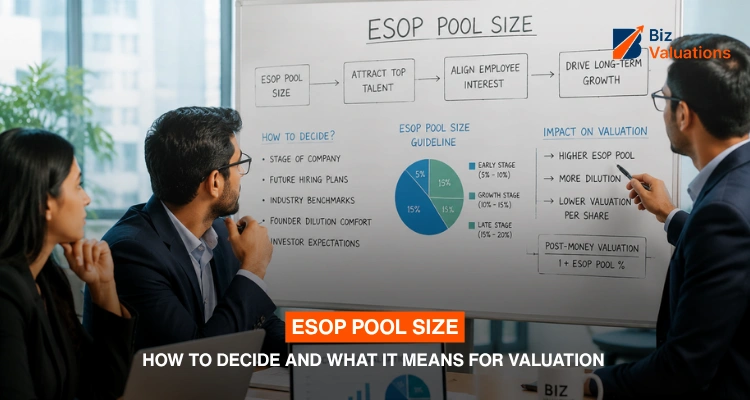
The option pool is the number of shares reserved for employee and other equity awards. For example, fully diluted shares of 10 million and an ESOP pool of 1.5 million equals 15 percent of fully diluted capitalisation. Investors often negotiate pool size during funding rounds because future grants dilute existing shareholders.
15. ESOP Pool Expansion
An ESOP pool expansion occurs when the company increases the shares reserved for employee equity. If an existing pool is 8 percent and investors want a post-financing pool of 15 percent, additional shares must be created. Whether the expansion is calculated pre-money or post-money determines who bears most of the dilution and can materially affect founder ownership.
16. Dilution
Dilution occurs when additional shares are issued and an existing shareholder's percentage ownership declines. A founder owning 1,000,000 of 1,000,000 shares (100 percent) who later sees the company issue another 250,000 shares ends up with 80 percent ownership. The number of shares owned stays the same; the percentage falls. Employees holding options are similarly affected by future dilution.
17. Fully Diluted Shares
Fully diluted shares generally represent the total shares outstanding assuming relevant outstanding equity instruments are converted or exercised. Depending on context, this may include common shares, preferred shares, options, warrants, RSUs, SAFEs, convertible notes, and other rights. Precise definitions vary, so employees should ask what percentage their grant represents on a fully diluted basis.
18. Ownership Percentage
Approximate ownership from a grant equals employee options divided by fully diluted shares. A grant of 50,000 options against 10 million fully diluted shares is roughly 0.50 percent. That percentage can shrink as the company raises capital and expands its option pool.
ISO, NSO, and Tax-Related Terms
19. ISO: Incentive Stock Option
An Incentive Stock Option (ISO) is a U.S. tax-qualified stock option meeting the requirements of Section 422. ISOs can generally be granted only to employees and must satisfy rules on plan approval, grant timing, exercise price, option term, employment status, transferability, and holding periods. The exercise price must generally be at least FMV on the grant date, and the term is typically limited to no more than 10 years, with special rules for certain 10 percent shareholders.
20. NSO / NQSO: Nonqualified Stock Option
A Nonqualified Stock Option (NSO or NQSO) does not qualify for ISO tax treatment. NSOs may be granted more broadly to employees, directors, consultants, and advisers depending on plan terms and applicable law. For most nonstatutory options without a readily determinable market value, the difference between the stock's FMV at exercise and the amount paid is generally treated as compensation income at exercise.
21. ISO vs NSO
The distinction is primarily tax and eligibility related. An ISO can receive more favourable U.S. tax treatment if statutory requirements and holding periods are met. An NSO is more flexible but typically creates ordinary compensation income upon exercise. The right choice depends on employee status, grant size, tax planning, exercise timing, company structure, and individual circumstances. Personal tax advice is essential before exercise.
22. $100,000 ISO Limit
U.S. tax law limits the amount of stock that can first become exercisable as an ISO during a calendar year to $100,000 of aggregate grant-date FMV of the underlying shares. Amounts above the limit are generally treated as nonqualified options. This is not a limit on eventual profit; it concerns the grant-date FMV of shares becoming exercisable for the first time in the year.
23. 83(b) Election
A Section 83(b) election allows a taxpayer receiving substantially nonvested property to elect to include value in taxable income at the time of transfer rather than when the property later vests. It is particularly relevant for founder restricted stock and early-exercised options that result in unvested shares. Timing requirements are strict; qualified tax advice is essential.
Restricted Stock, RSUs, and Vesting Triggers
24. Restricted Stock
Restricted stock is actual stock issued to an employee or founder but subject to restrictions such as vesting or repurchase rights. Unlike an option, the recipient may already hold the shares, though they remain subject to forfeiture. Restricted stock is especially common for founders and very early employees.
25. Restricted Stock Unit (RSU)
A Restricted Stock Unit (RSU) is a contractual promise to deliver shares or equivalent value after specified vesting or settlement conditions. Unlike an option, an RSU typically does not require payment of a conventional exercise price. RSUs are common at public companies and increasingly used by later-stage private companies. Private-company RSUs can involve complications around liquidity, settlement, taxation, double-trigger vesting, and timing.
26. Single-Trigger Vesting
Single-trigger vesting accelerates vesting upon one specified event, such as a change of control. If 25 percent of an employee's unvested grant becomes vested immediately upon acquisition, that is single-trigger acceleration. Investors and acquirers often scrutinise these provisions because they can accelerate significant equity before closing.
27. Double-Trigger Vesting
Double-trigger vesting usually requires two events: the company is acquired, and the employee is terminated without cause or resigns for good reason within a defined period. This structure balances employee protection with the acquirer's interest in retaining key people.
28. Acceleration
Acceleration means some or all unvested equity becomes vested earlier than scheduled. It can apply upon acquisition, IPO, termination, death, disability, or other contractual events and may be partial or full. For example, 60,000 unvested options with 50 percent acceleration means 30,000 vest immediately; the rest remain subject to the original schedule.
29. Early Exercise
Early exercise allows an employee to exercise options before they are fully vested. The resulting shares may remain subject to the company's repurchase or forfeiture rights. Early exercise can create tax consequences and may interact with an 83(b) election. It also requires committing cash to illiquid shares years before any exit, which is an important risk to evaluate carefully.
Option Value: Spread, Intrinsic Value, and Time Value
30. Exercise Date
The exercise date is when the option holder formally exercises the right to acquire shares. Share value may have risen substantially since grant. For example, if the grant-date FMV and exercise price were $1, and FMV at exercise is $8, the $7 difference is the spread and is often central to tax calculations for NSOs.
31. Spread
The spread equals FMV at exercise minus exercise price. For example, if the exercise price is $2 and FMV at exercise is $10, the spread is $8 per share. For 25,000 options, the total spread is $200,000. This figure is highly relevant for tax purposes.
32. In-the-Money Option
An option is in the money when current share value exceeds the exercise price. For example, if the exercise price is $2 and the current FMV is $7, the intrinsic value is $5 per option. A grant of 20,000 such options has $100,000 of gross intrinsic value before taxes, exercise cost, marketability, dilution, and other factors.
33. At-the-Money Option
An option is at the money when the exercise price approximately equals current share value. Immediate intrinsic value is zero, yet the option can still have economic value because of the possibility of future appreciation before expiration.
34. Underwater Option
An option is underwater when the exercise price exceeds current share value. For example, if the exercise price is $8 and the current value is $5, exercising would mean paying more than the shares are currently worth, so the option has no immediate intrinsic value. It may still gain value if the share price later rises above the exercise price before expiration.
35. Intrinsic Value
Intrinsic value is generally current share value minus exercise price, but not below zero for a conventional option. For example, if the current value is $12 and the strike is $4, intrinsic value is $8. For 50,000 vested options that equals $400,000. This is not the amount the employee will necessarily receive after taxes, transaction costs, liquidity constraints, dilution, and future performance.
36. Time Value
An option can have economic value even with little or no intrinsic value. That additional component is time value, reflecting the remaining period before expiration during which share value could increase. Option-pricing models consider share value, exercise price, volatility, expected term, risk-free rate, and dividends.
37. Expiration Date
The expiration date is the final date on which the option can normally be exercised. Options do not last forever. Many U.S. plans use terms of up to 10 years from grant, though actual terms vary. Valuable vested options that go unexercised before expiration are simply lost.
38. Post-Termination Exercise Window
This is the time an employee has to exercise vested options after leaving the company. Historically many startup plans used 90-day windows; some now offer longer periods. The exact agreement controls. An employee leaving with 100,000 vested options at a $2 exercise price may suddenly need $200,000 to exercise before the window closes. For ISOs, the tax classification can also be affected by how long after employment the option remains unexercised.
39. Forfeiture
Forfeiture means losing the right to an award. Unvested options are commonly forfeited on termination. Vested but unexercised options may also be forfeited if not exercised within the required post-termination period. Always check the plan and grant agreement.
40. Exercise Cost
Exercise cost equals number of options exercised times exercise price. For example, 80,000 options at $0.75 equals $60,000. Employees should calculate this figure (and potential tax) before assuming they can economically exercise all vested options.
Liquidity Events, Exits, and Monetisation
41. Liquidity Event
A liquidity event allows shareholders to convert otherwise illiquid private-company equity into cash. Examples include acquisition, merger, IPO, tender offer, or secondary sale. Employees should not assume a startup will necessarily experience one; some companies remain private for many years.
42. Exit
An exit is a transaction that allows founders, employees, or investors to monetise ownership. Common forms include strategic acquisition, private-equity sale, merger, IPO, recapitalisation, or secondary transaction. An option's ultimate value depends heavily on the exit price and the capital structure that sits ahead of common stock.
43. Tender Offer
A tender offer allows eligible shareholders or option holders to sell shares under specified terms. Private startups sometimes conduct employee tender offers before an IPO, for example offering to purchase up to a set percentage of vested shares at a stated price during a limited window. These can provide partial liquidity while the company remains private.
44. Secondary Sale
A secondary sale occurs when an existing shareholder sells shares to another buyer rather than the company issuing new primary shares. Sellers may include founders, employees, early investors, or former employees. Prices can provide useful market evidence of value but depend on share class, transaction size, transfer restrictions, information rights, buyer motivation, and liquidity discounts.
Preferred Stock, Common Stock, and Capital Structure
45. Preferred Stock
Preferred stock is commonly issued to venture investors and may carry rights that common shares lack, including liquidation preference, conversion rights, participation rights, anti-dilution protection, dividends, voting rights, and protective provisions. This is one reason the latest financing price cannot automatically be treated as the FMV of employee common stock.
46. Common Stock
Common stock is the ordinary equity class typically held by founders, employees (after exercise), and other common shareholders. Common shares are usually subordinate to preferred stock in the capital structure, which can materially affect their value.
47. Liquidation Preference
A liquidation preference gives preferred investors priority over common shareholders in certain exit or liquidation scenarios. For example, if an investor put in $20 million with a 1x preference and the company sells for $25 million, the preferred investor may receive the first $20 million before common shareholders participate. This can dramatically reduce employee equity value in modest exits. Headline company valuation does not tell the whole story.
48. Participating Preferred
Participating preferred may allow an investor both to receive its liquidation preference and to participate in remaining proceeds with common shareholders. This reduces the amount available to common stock. Many venture structures use non-participating preferred, but exact terms vary and must be examined.
49. Cap Table
A capitalisation table (cap table) shows the company's ownership structure and may include founders, investors, employees, preferred and common stock, options, warrants, SAFEs, and convertible notes. A clean, current cap table is essential for understanding dilution and employee ownership percentages.
50. Option Pool Shuffle
The option pool shuffle refers to negotiation over whether an expanded ESOP pool is included in the pre-money capitalisation before a financing. If investors require an additional 10 percent pool and it is created pre-money, much of the dilution falls on founders and existing investors rather than the new investor. This can change the economics of a round even when the headline valuation stays the same.
Exercise Mechanics: Cashless Exercise, Net Exercise, and More
51. Cashless Exercise
A cashless exercise allows the holder to exercise without paying the full exercise price entirely from personal cash, usually by arranging a simultaneous sale or using part of the resulting shares. This is generally easier for publicly traded shares or when a liquidity transaction is available. Private startup employees often cannot rely on it because no ready market exists.
52. Net Exercise
In a net exercise, the company withholds a portion of the shares otherwise issuable to cover the option exercise cost. The employee receives fewer shares instead of paying cash for all of them. Availability depends on the plan and company policy.
Valuation Models and Allocation Methods
53. Black-Scholes Model
The Black-Scholes Option Pricing Model estimates the fair value of options using inputs such as underlying share value, exercise price, expected volatility, option term, risk-free rate, and expected dividends. Companies may use it for financial reporting and valuation. The Black-Scholes value is not the same as intrinsic value.
54. OPM: Option Pricing Method
The Option Pricing Method (OPM) is frequently used in private-company valuations to allocate total equity value among different share classes. It treats the various securities as options on the company's total equity value at different breakpoints and can incorporate liquidation preferences, conversion thresholds, participation rights, seniority, volatility, and expected liquidity horizon. It is often relevant to 409A valuations. OPM is well-suited for early-stage and growth-stage companies with uncertain exit timing.
55. PWERM: Probability-Weighted Expected Return Method
The Probability-Weighted Expected Return Method (PWERM) estimates equity value under different future scenarios such as IPO, strategic sale, private financing, continued private operation, or downside/failure. Each scenario receives a probability and the resulting values are probability-weighted. PWERM is particularly useful when a company is approaching a known liquidity or financing event, typically within 12 to 18 months of a targeted IPO or sale.
56. Backsolve Method
A backsolve uses a recent arm's-length financing transaction to infer total company equity value. If investors paid $10 per preferred share, the appraiser cannot simply declare every common share also worth $10 because preferred shares carry special rights. An allocation model determines the total equity value implied by the observed preferred price and then allocates that value across the capital structure.
57. Discount for Lack of Marketability (DLOM)
A Discount for Lack of Marketability (DLOM) reflects the reduced value of an investment that cannot readily be sold. Private-company common shares are generally far less liquid than publicly traded shares. A 409A valuation may incorporate a DLOM where appropriate. Typical ranges fall between 15 to 50 percent depending on the company's stage, expected time to liquidity, and other factors. The percentage should be supported by facts and methodology rather than chosen arbitrarily.
58. Change of Control
A change of control generally refers to a transaction in which control of the company changes, such as an acquisition, merger, sale of substantially all assets, or transfer of majority voting control. The precise definition appears in the plan or transaction documents. Change-of-control provisions can affect vesting and acceleration.
Paper Value vs Realized Value
59. Paper Value
Paper value is the informal theoretical value of equity based on a current valuation, financing price, or internal estimate. For example, 50,000 options with a current common FMV of $8 and an exercise price of $1 yield a gross intrinsic paper value of $350,000. This is not cash. The employee may be unable to sell, future value may change, taxes may be due, and the company could fail. Paper wealth is not realised wealth.
60. Realized Value
Realized value is the amount actually monetised through a sale or liquidity event after exercise costs, taxes, and transaction expenses. Headline proceeds of $500,000 can look very different after subtracting $50,000 of exercise cost and $120,000 of tax. Realized value is the number that ultimately matters.
How to Estimate the Potential Value of an ESOP Grant
A simple starting point is: Potential Gross Intrinsic Value = Number of Vested Options x (Share Value - Exercise Price). For example, 30,000 vested options with an exercise price of $2 and an estimated common share value of $12 produce $300,000 of gross intrinsic value. This calculation ignores taxes, future dilution, liquidation preferences, transaction costs, remaining vesting, marketability, exercise timing, and future company performance. Treat it only as an illustrative figure.
ESOP Value vs. Company Valuation
One of the most common mistakes is dividing company valuation by shares outstanding without examining the capital structure. A $500 million valuation and 50 million fully diluted shares does not automatically mean every common share is worth $10. Substantial preferred stock with liquidation preferences, debt, or different rights can leave common stock worth considerably less. This is why 409A valuations and equity-allocation analyses matter.
Why a New Funding Round Does Not Automatically Set Your Option Value
If a Series C investor pays $20 per preferred share and an employee's exercise price is $2, it is tempting to claim an $18 per-option value. However, preferred shares may include liquidation preference, seniority, downside protection, conversion rights, and anti-dilution protection. Common shares may therefore be worth less than $20. Professional valuation allocates value across the securities according to their rights. Understanding this difference is one of the most important takeaways for any employee holding stock options.
What Happens to ESOPs When the Company Is Acquired?
Treatment depends on the acquisition agreement and equity plan. Possible outcomes include cashing out vested options, assuming the options, replacing them with buyer equity, accelerating vesting, cancelling underwater options, converting shares into buyer stock, or continuing vesting under replacement awards. Employees should not assume all options automatically convert to cash. Transaction documents control the result.
What Happens if the Company Fails?
Employee equity is a risk investment. If the company fails and has insufficient value to satisfy creditors and preferred shareholders, common stock may receive nothing. An employee who exercises options may lose the entire cash outlay. Exercising private-company options therefore requires careful financial and tax consideration.
Final Thoughts: The Number of Options Is Only the Beginning
When an employee receives an offer containing stock options, the first instinct is often to focus on the headline number. That number alone tells very little. The employee needs to understand the percentage of the company those options represent on a fully diluted basis, the exercise price relative to current common-share FMV, the precise vesting schedule and any cliff, what happens on termination, when the options expire, whether they are ISOs or NSOs, how much cash will be required to exercise, what taxes could arise, what preferred shares sit ahead of common stock, and how much dilution is likely before an exit.
Only after those questions are answered does the equity grant become understandable. For founders the same principle applies. Employee equity is a powerful recruiting and retention tool only when it is designed, valued, communicated, and administered with clarity. A poorly explained ESOP can produce the opposite effect: employees overestimate value, misunderstand exercise obligations, leave without realising options are about to expire, or equate a large headline fundraising valuation with the per-share value of their common options.
Clear terminology helps prevent those problems. Credible valuation helps solve the rest by distinguishing enterprise value, equity value, preferred-share value, common-share value, exercise price, grant-date FMV, liquidation preferences, marketability, and security-specific rights. That distinction is especially important for private startups, where no quoted share price is available every day.
Ultimately an ESOP represents an opportunity to participate in the future value of a company. It is not a guarantee. The employee may receive substantial value if the company grows and reaches a successful liquidity event. The employee may receive little or nothing if the company underperforms.
The best starting point is therefore not "How many options did I receive?" but "What rights do these options give me, what must happen before I own the shares, and what economic value could ultimately reach common shareholders?"
Once vesting, cliff, exercise price, fair market value, dilution, liquidation preference, 409A valuation, and liquidity are understood, the rest of the ESOP conversation becomes far more practical. That is the purpose of a good ESOP glossary: not merely defining terms, but helping employees and founders see how those terms fit together economically and what they mean for real-world outcomes.
For an independent, defensible valuation of your ESOP, equity instruments, or common stock, Biz Valuations provides expert-led reports accepted by auditors, investors, regulators, and courts. With 3,500+ certified valuations across 35+ industries, our IBBI Registered Valuers and SEBI Category I Merchant Banker credentials ensure your valuation meets every compliance standard. Request Your Valuation Quote Today
Top 10 Frequently Asked Questions About ESOPs and Stock Options

Mr. Saurobh Barick
Registered Valuer (IBBI) & Valuation Expert
DCF & Fair Market Value Valuations | FEMA, Income Tax & Companies Act | 409A Valuation | M&A, Fundraising valuation | Cross-Border & Startup/Business Valuation | SME IPO AdvisorySaurobh Barick is a Registered Valuer with the Insolvency and Bankruptcy Board of India (IBBI) and a finance professional with over 15 years of experience in valuation and financial advisory services.