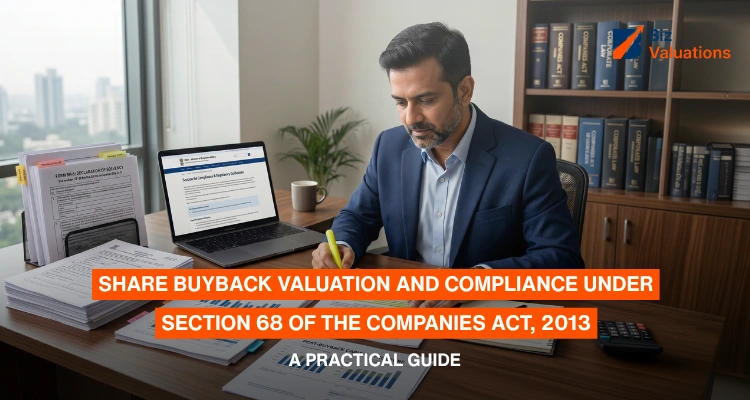
Share Buyback Valuation and Compliance under Section 68 of the Companies Act, 2013: A Practical Guide
 Saurobh Barick
on
Saurobh Barick
on
Share buybacks have become one of the most actively used capital management tools among Indian companies. Whether the goal is to return surplus cash to shareholders, shore up financial ratios, or send a confidence signal to the market, a buyback requires careful planning. And at the center of that planning sits one critical question: what is a fair price to repurchase shares?
Section 68 of the Companies Act, 2013, read alongside the Companies (Share Capital and Debentures) Rules, 2014 and SEBI regulations for listed entities, provides the legal architecture for share buybacks in India. But compliance alone is not enough. A well-supported valuation is what separates a buyback that holds up to regulatory and shareholder scrutiny from one that creates legal exposure.
This practical guide walks you through the full picture: what a buyback involves, what the law requires, how valuation works, and what pitfalls to avoid.
What Is a Share Buyback?
A share buyback, also called a share repurchase, occurs when a company purchases its own shares from existing shareholders. The immediate effect is a reduction in the total number of outstanding shares. Over time, this can improve key financial metrics.
Companies typically pursue buybacks for several reasons:
- To deploy surplus cash in a value-accretive way
- To improve financial ratios such as earnings per share (EPS) and return on equity (ROE)
- To provide price support when management believes shares are undervalued
- To reduce the risk of hostile takeover bids
- To optimize the overall capital structure
Each of these motivations has its own valuation implications, which is why a one-size-fits-all pricing approach rarely works.
Legal Foundation: Section 68 of the Companies Act, 2013
Section 68 of the Companies Act, 2013 is the primary statutory basis on which Indian companies are authorized to buy back their shares or specified securities. The provision comes with a structured set of conditions designed to protect shareholders, creditors, and the integrity of the company's capital base.
Here is what the law requires:
1. Authorization in the Articles of Association: The company's Articles of Association (AOA) must expressly permit a buyback. If this provision is absent, the AOA must be amended before any buyback process can begin.
2. Approval Mechanism: Two levels of approval apply depending on the scale of the buyback:
- A board resolution alone is sufficient when the buyback does not exceed 10% of the aggregate of paid-up equity capital and free reserves.
- A special resolution at a general meeting is required if the buyback exceeds 10%, up to the overall permissible cap.
3. Overall Limit: The total buyback cannot exceed 25% of the aggregate paid-up capital and free reserves. For equity shares specifically, the 25% ceiling applies to the total paid-up equity capital in that financial year.
4. Debt-Equity Ratio: After the buyback is complete, the company's total debt must not exceed twice the aggregate of paid-up capital and free reserves. A higher ratio may be permitted only where the Central Government specifies otherwise for particular classes of companies.
5. Eligible Shares: Only fully paid-up shares or securities qualify for a buyback. Partly paid shares are not eligible.
6. Permitted Funding Sources: A buyback may be funded from free reserves, the securities premium account, or the proceeds of a fresh issue of shares or specified securities. However, it cannot be funded from proceeds of an earlier issue of the same kind of shares.
7. Completion Timeline: The entire buyback exercise must be completed within one year from the date of the enabling resolution, whether by the board or by shareholders.
8. Cooling-Off Period: For six months following the completion of a buyback, the company cannot issue the same kind of shares or securities. Exceptions apply for bonus issues, rights issues, and employee stock option plans.
These conditions collectively ensure that buybacks are conducted in a financially responsible manner and do not compromise the interests of creditors or remaining shareholders.
Why Valuation Matters in Buybacks
Valuation is not an administrative formality in a share of buyback. It is the foundation on which the fairness of the entire transaction rests.
Setting the repurchase price too low risks allegations of shareholder oppression, particularly if minority shareholders are being squeezed out. Setting it too high may amount to an unjustified transfer of value, drawing scrutiny from tax authorities or auditors. Either way, an inadequately supported buyback price creates really legal and commercial risk.
Section 68 does not explicitly mandate an independent valuation report in every buyback scenario. But commercial prudence, and increasingly regulatory expectation, strongly points in that direction. This is especially true for:
- Unlisted and private companies, where there is no market price to reference
- Buybacks involving related parties, where conflicts of interest must be demonstrably managed
- Listed companies, where SEBI regulations impose additional pricing and disclosure disciplines
An independent valuation anchors the buyback price in defensible methodology, demonstrates good faith to shareholders, and provides the board with documented support for its decisions. Biz Valuations has delivered over 3,500 certified valuation engagements across 35+ industries, including buyback and restructuring scenarios.
Common Valuation Approaches for Buybacks
Section 68 does not prescribe a specific valuation method. What it requires is that the price be reasonable, consistent, and supportable. In practice, qualified valuers apply one or more of the following approaches depending on the nature of the business.
Net Asset Value (NAV) Method
Formula: NAV per share = (Total Assets -- Total Liabilities) / Number of Outstanding Shares
This method values the company based on the net worth of its balance sheet. It works well for asset-heavy businesses such as holding companies, real estate firms, and investment companies. The limitation is that it does not capture future earnings power or intangible value.
Discounted Cash Flow (DCF) Method
The DCF approach projects the company's future free cash flows and discounts them back to present value using an appropriate rate that reflects the risk profile of the business. This method captures intrinsic value and is well-suited to growth-stage companies or businesses with irregular historical performance. Its primary sensitivity lies in the assumptions used for growth rates and the discount rate.
Market Price-Based Methods (Listed Companies)
For publicly listed companies, recent trading data provides a reference point. This typically means volume-weighted average price (VWAP) or average closing prices over a defined period. SEBI regulations govern the floor and ceiling prices applicable to the tender offer route, which remains the primary permitted method for listed company buybacks following the phasing out of open-market buybacks via stock exchanges after March 31, 2025 (with ongoing regulatory discussions around potential reintroduction as of early 2026).
Earnings Multiples (P/E Approach)
This method applies to an appropriate industry price-to-earnings ratio to the company's current or normalized EPS. It is most suitable for stable, profit-generating businesses in sectors where reliable listed comparables exist.
Comparable Company Analysis
This approach benchmarks the subject company against publicly listed peers, using valuation multiples such as EV/EBITDA or P/E ratios. It is particularly useful for cross-validation of the primary methodology.
In practice, a hybrid approach combining NAV, DCF, and earnings or market metrics often delivers the most defensible and balanced valuation. This is the approach followed by Biz Valuations, where each methodology is applied and weighed based on the specific context of the buyback.
Role of a Registered Valuer or Independent Expert
While Section 68 does not universally mandate an independent valuation expert, the case for engaging one is compelling across most buyback scenarios.
For listed companies, a Merchant Banker registered with SEBI is required for the valuation and certification process. For unlisted and private companies, a Registered Valuer under Section 247 of the Companies Act or a Chartered Accountant with relevant expertise typically performs this role.
An independent report serves multiple purposes. It strengthens the board's decision-making process by providing an objective price benchmark. It reduces the risk of future challenges from shareholders, tax authorities, or the National Company Law Tribunal. And it demonstrates that the company has acted in good faith toward all stakeholders.
Step-by-Step Buyback Process under Section 68
A compliant buyback follows a defined procedural sequence. Skipping or delaying any step creates legal exposure.
1. Verify that the Articles of Association authorize a buyback.
2. Convene a board meeting to approve the buyback proposal. If the buyback is within 10% of paid-up capital and free reserves, pass the board's resolution at this stage.
3. Where the buyback exceeds 10%, obtain shareholder approval through a special resolution at a general meeting.
4. File a declaration of solvency in Form SH-9 with the Registrar of Companies (ROC), signed by at least two directors (including the managing director, where applicable).
5. Open a dedicated escrow or bank account specifically for the buyback.
6. Issue the offer letter in Form SH-8 to all eligible shareholders.
7. Receive and accept shares tendered by shareholders.
8. Extinguish and physically destroy the bought-back shares within seven days of the buyback's completion.
9. File the return of buyback in Form SH-11 with the ROC within 30 days of completion.
For listed companies, additional SEBI compliance obligations apply across each stage, including public announcements, disclosures to stock exchanges, and adherence to the permitted buyback route (primarily tender offers as of 2026).
Pricing Considerations
Listed Companies
SEBI regulations specify the framework within which the buyback price must be set. This includes floor and ceiling calculations, disclosure obligations, and the method by which the tender offer is conducted. The buyback price must be stated clearly in the offer document and must be justifiable relative to recent market performance.
Unlisted Companies
In the absence of a traded market price, the buyback price must be anchored in a credible independent valuation. The chosen methodology should balance the company's intrinsic worth with its capacity to sustain the buyback without compromising financial health. The interests of both exiting and continuing shareholders must be equitably considered.
Tax Implications: Updated Position
Buyback taxation in India has undergone significant changes in recent years.
Until September 30, 2024, the tax burden sat entirely with the company. Under Section 115QA, companies paid a special distribution tax of approximately 23.3% (including applicable surcharge and cess) on the distributed income. Shareholders received their buyback proceeds entirely tax-free.
From October 1, 2024, this framework was reversed. The company-level tax under Section 115QA was abolished. Buyback proceeds are now taxed as capital gains in the hands of shareholders, with specific provisions governing cost basis determination and holding period classification. Further refinements were proposed in subsequent union budgets to bring the treatment more in line with ordinary share sale transactions.
This shift has significant implications for both companies and shareholders in structuring their buyback decisions. Professional tax advice is strongly recommended, as the rules continue to be refined.
Buyback vs. Dividend: Key Differences
| Aspect | Buyback | Dividend |
|---|---|---|
| Tax Burden | Taxed as capital gains in shareholders' hands (post-2024) | Taxed in shareholders' hands as income |
| Flexibility | Higher (participation is selective) | Lower (distribution is pro-rata to all) |
| Market Signal | Often interpreted positively by the market | Generally, a neutral or routine signal |
| Ownership Impact | Can increase promoter's proportionate stake | No change in relative ownership |
Common Pitfalls to Avoid
Even well-intentioned buybacks can go wrong at the execution stage. Watch out for:
- Failing to document and justify the buyback price with adequate supporting evidence
- Breaching the 25% aggregate limit on paid-up capital and free reserves
- Exceeding the 2:1 post-buyback debt-equity ceiling
- Delays in share extinguishment or in filing Forms SH-9 and SH-11 with the ROC
- Incomplete or inaccurate documentation accompanying the solvency declaration
- Overlooking the six-month restriction on fresh issuance of the same class of shares following completion
Strategic Factors Before Proceeding
A buyback is not the right move in every situation, even where it is legally permissible. Before committing, management should evaluate:
- Available surplus cash: Is the liquidity position strong enough to support the buyback without restricting operational needs?
- Liquidity impact: Will the buyback leave the company with adequate working capital buffers?
- Market perception: How is the buyback likely to be interpreted by investors, analysts, and creditors?
- Regulatory environment: Are there any pending SEBI or MCA changes that could affect buyback mechanics?
- Tax efficiency: Under the current capital gains framework, does a buyback deliver better after-tax outcomes for shareholders compared to a dividend?
A buyback typically makes the most strategic sense when the company's shares are perceived to be trading below intrinsic value, the business has strong fundamentals, and there are no near-term high-return investment opportunities competing for the same capital.
Impact on Financial Statements
A completed buyback reduces the share of capital and reserves on the company's balance sheet. This reduction in the equity base typically improves EPS, since the same earnings are now distributed across fewer shares. It may also support the share price, at least in the near term. Accounting treatment must follow applicable Indian Accounting Standards (Ind-AS) or the relevant accounting framework, and the entries must be reflected accurately in the financial statements filed with the ROC.
Governance Best Practices
A well-governed buyback process follows these principles:
- Engage independent valuation expertise before setting the repurchase price
- Ensure the audit committee or full board formally reviews and approves the valuation and process
- Treat all shareholders equitably, regardless of size or relationship to the promoter group
- Maintain full transparency through timely public disclosures and regulatory filings
Strong governance is not just a compliance requirement. In a high-trust service like share repurchase, it is the foundation on which shareholder confidence is built.
Recent Developments
Buybacks remain particularly popular in cash-rich sectors such as information technology, pharmaceuticals, and FMCG. Regulatory attention has intensified around two themes: ensuring equitable participation by all shareholder classes and achieving greater tax neutrality between different distribution mechanisms.
On the process side, SEBI has streamlined several procedural requirements while simultaneously phasing out the open-market route via stock exchanges (effective March 31, 2025). Discussions around a potential reintroduction of this route under the revised tax framework were ongoing as of early 2026. Companies and their advisors should monitor any further SEBI circulars closely.
Conclusion
A share buyback under Section 68 of the Companies Act, 2013, when executed with discipline, is a powerful tool for capital optimization and shareholder value creation. But it is only as strong as the valuation that underpins it.
Valuation is not a box to tick. It is evidence that the buyback price is fair, the transaction is compliant, and the interests of all stakeholders have been considered. Without robust valuation support, even a technically legal buyback can attract shareholder disputes, regulatory scrutiny, or tax challenges.
Companies approaching a buyback should follow a structured path: verify authorization, secure proper resolutions, obtain independent valuation support where needed, complete every procedural step in sequence, and maintain thorough records throughout. Engaging professional advisors such as company secretaries, valuers, and legal counsel is the most effective way to navigate complexity successfully.
A thoughtfully structured buyback does more than optimize the balance sheet. It reinforces the market's confidence in the company's governance and its long-term strategic direction.
Frequently Asked Questions (FAQs)

Mr. Saurobh Barick
Registered Valuer (IBBI) & Valuation Expert
DCF & Fair Market Value Valuations | FEMA, Income Tax & Companies Act | 409A Valuation | M&A, Fundraising valuation | Cross-Border & Startup/Business Valuation | SME IPO AdvisorySaurobh Barick is a Registered Valuer with the Insolvency and Bankruptcy Board of India (IBBI) and a finance professional with over 15 years of experience in valuation and financial advisory services.