ESOP Valuation in India: The Complete Compliance Guide (Grant, Vest & Exercise)
 Saurobh Barick
on
Saurobh Barick
on
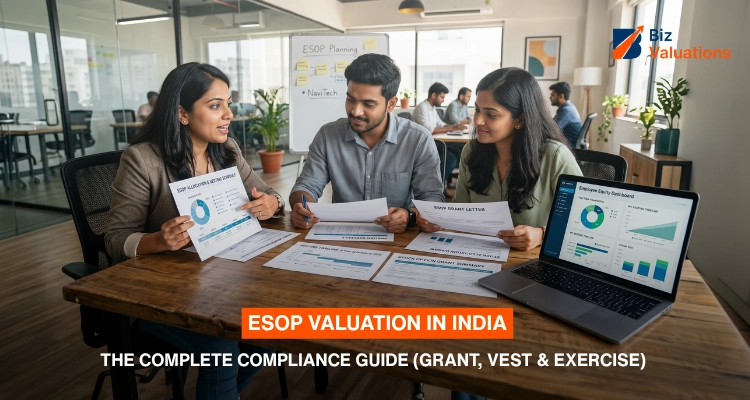
Employee Stock Option Plans have become one of the most powerful tools for building high-performance teams in India. Startups, growth-stage companies, and even established private firms now use ESOPs to attract talent, reward loyalty, and align employees with long-term business value.
But ESOP valuation in India is far more than a paperwork exercise. A poorly executed valuation can trigger tax disputes, attract regulatory scrutiny, create problems during fundraising, and leave employees with unexpected liabilities. Getting it right requires a clear understanding of what valuation is required, when it is required, and who is qualified to perform it.
This guide walks you through every stage of the ESOP lifecycle, covering the legal framework, valuation methods, taxation implications, accounting treatment, and common compliance mistakes. Whether you are a founder setting up your first ESOP scheme, a CFO managing a growing pool, or a legal advisor supporting a transaction, this is the reference you need.
Key Takeaways
- ESOP valuation in India is required at the grant, exercise, and accounting stages. Each triggers different legal, tax, and reporting obligations.
- For unlisted companies, the Fair Market Value of shares at exercise must be certified by a Category I Merchant Banker under Rule 11UA of the Income Tax Act, 1961.
- The perquisite tax at exercise is calculated as FMV on exercise date minus the exercise price. This is taxed as salary income and attracts TDS.
- Ind AS 102 requires recognition of share-based payment expense at grant date fair value, typically calculated using the Black-Scholes model.
- DPIIT-recognized startups that are also 80-IAC certified can defer perquisite tax on ESOP exercise, reducing immediate cash outflow for employees.
- ESOP pools typically range from 8 to 15 percent on a fully diluted basis. Structuring this pool correctly from the start avoids expensive corrections later.
- Valuations must be updated before each new grant cycle, after a funding round, and ahead of any major event such as a secondary sale or IPO.
- Both an IBBI Registered Valuer and a Category I Merchant Banker are relevant to ESOP compliance. They serve different regulatory purposes and are not interchangeable.
What is an ESOP?
An Employee Stock Option Plan gives employees the right, but not the obligation, to purchase company shares at a fixed price. That price is called the exercise price and is determined at the time the option is granted.
Employees do not receive shares immediately. They must first complete a vesting period or meet performance criteria. Once vested, they can pay the exercise price to acquire the shares. If the company's value has grown, the difference between the current share value and the exercise price becomes their financial gain.
Key Benefits of ESOPs Include:
- Attracting senior talent in competitive markets without offering high cash salaries
- Retaining key employees through multi-year vesting schedules
- Building a culture of shared ownership and accountability
- Preserving cash for product development and market expansion
- Creating meaningful wealth for employees when the company achieves a liquidity event
In India, ESOPs are governed by a multi-layered regulatory framework:
- Companies Act, 2013 (Section 62(1)(b) and Rule 12 of Share Capital Rules)
- SEBI (Share Based Employee Benefits and Sweat Equity) Regulations for listed companies
- Income Tax Act, 1961 (particularly Section 17(2)(vi) governing perquisite taxation)
- Ind AS 102 for accounting treatment
- FEMA for entities with foreign shareholders or non-resident employees
Each of these frameworks has its own valuation requirements. A single ESOP engagement can trigger obligations under more than one of them at the same time.
Understanding the ESOP Lifecycle
Every ESOP moves through three core stages. Understanding what happens at each stage, and what valuation is needed, is the foundation of good compliance.
Grant Stage
The company formally issues options through a grant letter. This document specifies the number of options, the exercise price, the vesting schedule, any performance conditions, and the expiry date. No shares are issued at this point, and in most cases, there are no immediate tax consequences.
However, the grant stage sets the foundation for everything that follows. The exercise price is typically set at or above the current Fair Market Value of the shares. If it is set below FMV without a proper valuation, the company exposes itself to regulatory risk. An accounting valuation under Ind AS 102 must also be performed at grant date to determine the fair value of the option itself, which becomes the basis for the share-based payment expense.
Board resolutions and shareholder approval via special resolution are required before options can be granted under the Companies Act, 2013.
Vesting Stage
Vesting is the process through which employees earn their options over time. A common structure is a one-year cliff followed by graded vesting over three to four years. For example, an employee might vest 25 percent of their options after completing one year, and the remainder in monthly or quarterly instalments over the following three years.
Vesting does not trigger a tax event. However, the company must track option holders, account for forfeitures in its financial statements, and recognize the proportional share-based payment expense under Ind AS 102 over the vesting period. Accurate record-keeping during this stage protects the company during audits and investor due diligence.
Exercise Stage
Exercise is the most significant stage from a valuation and taxation perspective. When an employee pays the exercise price to acquire shares, the company must determine the Fair Market Value of those shares on the date of exercise. The spread between the FMV and the exercise price is treated as a perquisite and taxed as salary income in the hands of the employee.
For unlisted companies, FMV at exercise must be certified by a Category I Merchant Banker. The report must typically not be older than 180 days at the time of exercise. After exercise, shares are allotted through a PAS-3 filing with the ROC. The employee becomes a shareholder, and any future gain on sale is treated as capital gains.
What is ESOP Valuation?
ESOP valuation refers to two related but distinct determinations:
1. Fair Market Value (FMV) of the underlying shares – used for setting the exercise price, calculating perquisite tax, and FEMA compliance
2. Fair value of the option itself – used for Ind AS 102 accounting and financial reporting
For unlisted companies, neither of these values is available on a stock exchange. Both must be determined through a formal valuation report prepared by a qualified professional.
Valuation requirements vary depending on the company type, its stage of growth, whether foreign shareholders are involved, and which specific regulatory obligation is being met. For most private companies in India, professional valuation reports are not optional. They are a legal requirement.
Why ESOP Valuation Matters in India
- Regulatory Compliance: The Companies Act, 2013 and SEBI's SBEB Regulations require that share issuances under ESOP schemes be supported by proper valuations. Non-compliance can attract ROC objections and penalties.
- Employee Taxation: At the exercise stage, the perquisite income is calculated using FMV. Without a certified FMV report, TDS cannot be correctly deducted, exposing both the employer and the employee to tax authority scrutiny.
- Financial Reporting: Ind AS 102 requires companies to recognize the fair value of options as an expense in their profit and loss account over the vesting period. This directly affects EBITDA, net profit, and key financial ratios reviewed by investors and auditors.
- Fundraising and Exits: Investors performing due diligence will closely examine the ESOP pool, the exercise prices used in past grants, and the methodologies behind each valuation. Defensible, professionally prepared reports build confidence and accelerate transactions.
- Risk Mitigation: A weak or missing valuation creates a chain of problems. These include tax re-assessment, audit qualifications, challenges in IPO filings, and disputes with employees who feel their options were undervalued.
Legal Framework Governing ESOP Valuation
Understanding the legal landscape is essential before structuring any ESOP scheme.
Companies Act, 2013 and Rule 12: Options can only be issued to full-time permanent employees, including working directors. Promoters and directors holding more than 10 percent of equity are excluded, except for DPIIT-recognized eligible startups. A special resolution (75 percent majority) of shareholders is required for approval. The minimum vesting period is one year.
Income Tax Act, 1961: Section 17(2)(vi) defines the perquisite at exercise as the FMV on exercise date minus the exercise price. For unlisted shares, FMV must be certified by a Category I Merchant Banker, and the valuation report must not be older than 180 days. The perquisite is included in the employee's taxable salary and is subject to TDS by the employer.
SEBI SBEB Regulations: These apply to listed companies and cover pricing methodology, trust structures, and disclosure requirements. An independent valuer must be appointed for any ESOP-related share issuance involving listed securities.
Ind AS 102 (Share-Based Payment): This accounting standard requires the grant-date fair value of options to be recognized as an expense over the vesting period. The most widely used model for this calculation is the Black-Scholes model. Any modification to the option terms, such as reducing the exercise price, may require re-measurement of the fair value.
FEMA: If the company has foreign direct investment on its cap table, or if it employs non-resident individuals, the allotment of shares under an ESOP triggers FEMA pricing guidelines and may require FC-GPR filings with the Reserve Bank of India.
ESOP Valuation Methods in India
The right valuation method depends on the purpose of the valuation, the nature of the business, and the applicable regulatory framework.
| Valuation Method | Primary Use | Best Suited For |
|---|---|---|
| Discounted Cash Flow (DCF) | FMV of shares for exercise, Rule 11UA, FEMA | Startups with clear revenue projections |
| Net Asset Value (NAV) | FMV for asset-heavy businesses | Mature, capital-intensive companies |
| Market Comparable Method | FMV benchmarking using peer transactions | Companies with identifiable listed peers |
| Black-Scholes Model | Option fair value under Ind AS 102 | All companies issuing standard ESOPs |
| Binomial / Lattice Model | Complex vesting structures | Performance-linked or market-condition options |
Discounted Cash Flow (DCF):Projects future free cash flows and discounts them back to present value using an appropriate discount rate. This is the most common method for startup share valuation due to its forward-looking nature and wide acceptance among venture investors and tax authorities.
Net Asset Value (NAV): Calculates value based on net assets on the balance sheet. More relevant for capital-intensive or mature businesses where historical assets are a reliable indicator of value.
Market Comparable Method: Applies earnings or revenue multiples derived from similar listed companies or recent funding transactions. Effective when strong comparable data exists for the industry.
Black-Scholes Option Pricing Model: The industry standard for calculating the fair value of the option itself under Ind AS 102. It incorporates six variables: the current share price, exercise price, expected term, risk-free interest rate, expected volatility, and expected dividend yield. Determining expected volatility for an unlisted company requires benchmarking against comparable listed peers.
Binomial or Lattice Models: These are more flexible than Black-Scholes and can handle complex features such as performance vesting, early exercise patterns, or market-condition-linked vesting. They are used where the standard Black-Scholes assumptions do not apply.
For tax purposes under Rule 11UA, merchant bankers most commonly use the DCF or market comparables approach for the underlying share FMV. The Black-Scholes model is then applied separately for the accounting valuation under Ind AS 102.
Who Can Issue ESOP Valuation Reports?
Not every valuation professional is qualified for every type of ESOP valuation in India. The right credential depends on the specific purpose.
IBBI Registered Valuer (Securities and Financial Assets): Recognized under the Companies Act, 2013 for share issuances and regulatory filings with the ROC and NCLT. Required or strongly recommended for Companies Act-related ESOP compliance.
Category I Merchant Banker (SEBI Registered): Mandatory for certifying FMV of unlisted shares for Income Tax purposes under Rule 11UA. This is the report that determines the perquisite tax at exercise. A Category I Merchant Banker registration is required specifically for this purpose. No other credential substitutes for it in this context.
International Certifications (ABV, ASA, CVA, MRICS): Professionals holding these credentials add credibility for cross-border transactions, 409A valuations for US-incorporated entities, and engagements involving global investors or auditors.
Biz Valuations holds both the IBBI Registered Valuer credential and the SEBI Category I Merchant Banker registration. This means a single engagement with Biz Valuations covers both the Companies Act and Income Tax requirements, without needing to coordinate between multiple advisors.
ESOP Valuation Across Lifecycle Stages
At Grant
At the grant stage, two things must happen before options are issued. First, the company must determine an appropriate exercise price. While the law does not always mandate that this equals FMV, setting it significantly below FMV without documentation can attract scrutiny. Second, the company must obtain an accounting valuation of the option's fair value for Ind AS 102 purposes. This grant-date fair value becomes the basis for the share-based payment expense recognized over the vesting period.
Board approval and shareholder special resolution must be completed before any grants are made. The ESOP scheme document, including all terms and conditions, should be finalised and filed with the ROC through Form MGT-14 within 30 days of the shareholder resolution.
At Vesting
Vesting does not create a tax event. However, the company must recognize share-based payment expense proportionally for each period based on the original grant-date fair value. If employees forfeit their options before vesting, the expense recognized for those forfeitures must be reversed. Accurate record-keeping of option holder status, vesting milestones, and forfeiture events is essential for clean financial statements.
At Exercise
Exercise triggers the most compliance activity. The company must obtain a fresh FMV certification from a Category I Merchant Banker. The spread between FMV and exercise price is reported as perquisite income in the employee's Form 16. TDS must be deducted accordingly. Shares are allotted through a PAS-3 filing, and the employee's register is updated.
For future capital gains tax, the FMV at exercise becomes the cost of acquisition. If the employee holds shares for more than 24 months (in the case of unlisted companies), the gain qualifies as long-term capital gains, taxed at 20 percent with indexation.
ESOP Accounting Under Ind AS 102
Ind AS 102 applies to all companies that issue equity-settled or cash-settled share-based payments, which includes ESOPs. The core principle is that the fair value of options granted should be recognized as an expense over the vesting period, with a corresponding increase in equity.
Here is a simplified example. A company grants options with a total grant-date fair value of Rs 2 crore. The options vest over four years. The company must recognize approximately Rs 50 lakh per year as share-based payment expense, adjusted for expected forfeitures and actual vesting outcomes. This expense reduces reported EBITDA and profitability, which matters significantly when preparing for fundraising or an IPO.
Detailed disclosures are required in the financial statements, including the number of options granted, exercised, forfeited, and outstanding, along with the weighted average exercise price and fair value assumptions used in the Black-Scholes model.
Accounting gets more complex when options are modified. If the exercise price is reduced after the original grant, the incremental fair value must be calculated and recognized as additional expense.
Special Provisions for DPIIT-Recognized Startups
DPIIT-recognized startups that are also certified as eligible startups under Section 80-IAC of the Income Tax Act, 1961 benefit from two significant advantages:
First, they can issue ESOPs to promoters and directors who hold more than 10 percent of the company's equity. This is not permitted for other private limited companies under the Companies Act.
Second, their employees can defer to perquisite tax on ESOP exercises. Instead of paying tax in the year of exercise, the tax can be deferred to the earliest of five years from the end of the relevant financial year, the date of sale of shares, or the date the employee leaves the company.
This deferral meaningfully reduces the immediate tax burden on employees, making the ESOP programme more attractive as a compensation tool. Companies should confirm their eligibility status before promising this benefit to employees, as both DPIIT recognition and 80-IAC certification are required.
FEMA Considerations
If your company has received foreign investment, or if you have non-resident employees, ESOP share allotments have additional compliance requirements under FEMA.
Shares allotted to non-resident employees or employees of foreign subsidiaries may require pricing compliance with RBI guidelines. For FDI transactions exceeding USD 5 million, only a SEBI Category I Merchant Banker can certify the FMV for RBI purposes. The allotment must be reported through an FC-GPR filing within 30 days.
Failure to comply with FEMA filing requirements can result in penalties and complications in future funding rounds or exit transactions.
ESOP Pool Strategy and Dilution Management
The ESOP pool is the total number of shares reserved for employee option grants. Most startups create an ESOP pool of 8 to 15 percent of the company on a fully diluted basis. The exact size depends on the stage of the company, the pace of hiring, and investor expectations.
A few important considerations for founders:
Timing of pool creation: Investors typically require an ESOP pool to be created before their investment is priced, so that the dilution from the pool falls on the founders rather than the investors. Understanding this dynamic before entering a funding round negotiation is important.
Refreshing the pool: As options vest and are exercised, or as the company hires more senior employees, the pool may need to be topped up. Each top-up requires a fresh shareholder resolution and an updated scheme document.
Acceleration provisions: Well-drafted ESOP schemes include provisions for vesting acceleration on acquisition or change of control events. Without this, employees may find their unvested options worthless if the company is acquired before their vesting period concludes.
Clawback provisions: These allow the company to reclaim options or shares from employees who leave on adverse terms. While not legally mandated for unlisted companies, including these provisions in the scheme document can protect the company's cap table integrity.
Common Pitfalls in ESOP Valuation
Even well-intentioned ESOP programmes run into compliance problems. These are the most common mistakes:
- Setting an exercise price below FMV without a supporting valuation report, creating perquisite tax exposure at grant
- Using an outdated valuation report for exercise. If the report is more than 180 days old, it is not valid for tax purposes
- Relying on a Chartered Accountant's certificate instead of a Category I Merchant Banker report for unlisted share FMV under Rule 11UA
- Skipping Ind AS 102 accounting entirely or calculating it incorrectly, leading to audit qualifications
- Not updating valuations after a funding round, which can result in mismatched exercise prices across grant cohorts
- Poor documentation of grant letters, board resolutions, and register of option holders, which creates serious problems during investor due diligence
- Ignoring FEMA obligations when foreign shareholders or non-resident employees are involved
ESOP Compliance Checklist for Indian Companies
Pre-Grant:
- Finalize the ESOP scheme document
- Obtain board approval and shareholder special resolution
- File Form MGT-14 with ROC within 30 days
- Obtain FMV valuation report from a Category I Merchant Banker
- Obtain Ind AS 102 fair value report (Black-Scholes)
- Issue grant letters to eligible employees
- Update ESOP register
During Vesting:
- Monitor vesting schedules for all option holders
- Track forfeitures and update records accordingly
- Recognize share-based payment expense in financial statements each period
At Exercise:
- Obtain fresh FMV certification from Category I Merchant Banker (within 180 days)
- Calculate perquisite income for each exercising employee
- Deduct TDS and reflect in salary computation
- Allot shares via board resolution and PAS-3 filing
- Update register of members and ESOP register
- File FC-GPR if foreign investment is involved
Ongoing:
- Review ESOP pool size before each funding round
- Update valuations before each new grant cycle
- Maintain audit-ready documentation for all grants, vestings, and exercises
- Review scheme document when capital structure changes significantly
The Evolving Landscape of ESOPs in India
The ESOP market in India is maturing quickly. With 18+ startup IPOs in 2025 and a growing pipeline for 2026, pre-IPO ESOP valuations are at their highest demand in recent years. Companies that issued ESOPs at seed stage are now approaching liquidity events, and the quality of past valuation work is facing real scrutiny.
Beyond traditional ESOPs, companies are exploring alternative equity compensation structures. Stock Appreciation Rights (SARs) offer employees the economic benefit of share price appreciation without share ownership. Restricted Stock Units (RSUs) provide shares outright after a vesting period. Phantom stock programmes replicate equity returns without actual share issuance.
Each of these structures has its own valuation and compliance requirements. Virtual ESOPs are also being used for global teams where actual share ownership creates cross-border complications.
As ESOP culture deepens across India's private sector, the expectations of employees, investors, and regulators around valuation quality and documentation will continue to rise. Investing in robust ESOP valuation from the beginning is a far better outcome than correcting deficiencies during a fundraise or acquisition.
Why Biz Valuations is the Premier Choice for ESOP Valuation Services in India
Navigating ESOP compliance requires a partner who understands corporate law, taxation, accounting, and financial modelling, and who holds the specific credentials required by each regulatory framework.
Biz Valuations bring all of this under one roof.
Comprehensive Services: The full range of ESOP-related valuation work, including ESOP valuation, startup valuation, fair market valuation, 409A valuations for US entities, Purchase Price Allocation, intangible asset valuation, and FEMA-compliant reports.
Dual Regulatory Authority: Reports are delivered by IBBI Registered Valuers for Companies Act purposes and by Category I Merchant Bankers for Income Tax FMV certification. Both frameworks are covered in a single engagement.
Global-Standard Certifications: Professionals holding ABV (Accredited in Business Valuation), ASA (Accredited Senior Appraiser), CVA (Certified Valuation Analyst), and MRICS credentials handle international assignments and 409A valuations, adding credibility with global investors and auditors.
Startup-Centric Expertise: Deep experience in cap table modelling, SAFE instruments, convertible notes, ESOP pool design, pre-IPO planning, and secondary liquidity programmes ensures that valuations align with the company's fundraising and exit strategy.
Audit and Investor-Ready Deliverables: Every report features transparent assumptions, detailed workpapers, and sensitivity analysis suitable for use in investor due diligence, statutory audits, tax assessments, and IPO filings.
With 3,500+ certified valuations delivered across 35+ industries over 15+ years, Biz Valuations is not just a report provider. It is a strategic partner for companies that take their ESOP programmes seriously.
Conclusion
ESOP valuation in India sits at the intersection of corporate law, taxation, accounting, and strategic workforce planning. Getting it right at every stage, from grant through vesting to exercise, protects the company, protects employees, and keeps the cap table clean for future transactions.
The regulatory requirements are clear: FMV at exercise must be certified by a Category I Merchant Banker, Ind AS 102 accounting requires a grant-date Black-Scholes valuation, and FEMA obligations must be addressed when foreign investment is involved. Each of these requirements has a specific credential attached to it, and using the wrong type of professional creates a compliance gap that is expensive to fix later.
For Indian startups and growth-stage companies, ESOPs are a long-term investment in talent and culture. Supported by defensible, professionally prepared valuations at every stage, they become a genuine competitive advantage.
Biz Valuations is ready to help you structure, value, and manage your ESOP programme from start to finish.
Top 10 FAQs on ESOP Valuation in India

Mr. Saurobh Barick
Registered Valuer (IBBI) & Valuation Expert
DCF & Fair Market Value Valuations | FEMA, Income Tax & Companies Act | 409A Valuation | M&A, Fundraising valuation | Cross-Border & Startup/Business Valuation | SME IPO AdvisorySaurobh Barick is a Registered Valuer with the Insolvency and Bankruptcy Board of India (IBBI) and a finance professional with over 15 years of experience in valuation and financial advisory services.