
ESOP vs Sweat Equity: Which Is Better for Your Startup?
 Saurobh Barick
on
Saurobh Barick
on
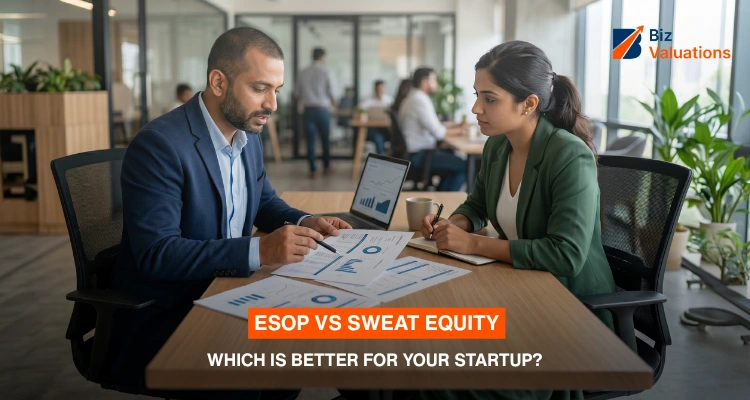
Building a high-performing team on a limited budget is one of the most consistent challenges startup founders faces. When cash is tight but the need for exceptional talent is urgent, equity-based compensation becomes the most powerful tool in a founder's arsenal.
Two instruments dominate the conversation: Employee Stock Option Plans (ESOPs) and Sweat Equity Shares. Both reward contributors with ownership. But they work very differently, carry distinct legal obligations, and serve different strategic purposes.
Choosing the wrong one can create compliance gaps, unwanted dilution, or investor friction down the road. Choosing the right one, at the right time, can build a team that is fully aligned with your startup growth trajectory.
This guide breaks down everything you need to know about ESOP vs Sweat Equity, so your startup makes the right call.
What Is an Employee Stock Option Plan (ESOP)?
An Employee Stock Option Plan (ESOP) is a structured compensation program through which a company grants employees the right to purchase shares at a fixed price, known as the exercise price or strike price, after completing a defined vesting period. The key word here is "right," not "obligation." Employees choose whether to exercise their options once they are vested.
Core Characteristics of ESOPs
1. Vesting Schedule ESOPs follow a vesting timeline, typically spanning three to four years with a one-year cliff. The cliff means no options to vest until the employee completes at least one year. After that, vesting usually happens monthly or quarterly. This structure directly protects the company from granting ownership to short-tenure hires.
2. Exercise Price The strike price is set at the time of grant. If the company's valuation rises significantly between grant date and exercise date, the employee gains the difference as financial upside. This is the fundamental incentive mechanism of any ESOP.
3. Deferred Ownership Employees do not become shareholders at the moment; options are granted. Ownership only transfers after vesting is complete, and the employee chooses to exercise. This allows founders to plan dilution more predictable.
4. Scalability for Large Teams ESOPs are designed for broad distribution. A well-structured ESOP pool, typically 10 to 15 percent of fully diluted shares, can accommodate dozens or even hundreds of employees across departments and seniority levels.
5. Governance and Investor Friendliness Venture capital and angel investors consistently expect startups to maintain an ESOP pool as part of sound governance. Most term sheets factor in the ESOP pool before calculating ownership percentages.
What Are Sweat Equity Shares?
Sweat equity shares are equity shares issued directly by a company to individuals who have contributed non-cash value, such as intellectual property, specialized technical expertise, or strategic insight that materially advances the business.
Unlike ESOPs, sweat equity does not involve an option or a purchase. Shares are allotted directly, making the recipient an immediate shareholder.
Core Characteristics of Sweat Equity
1. Immediate Share Ownership There is no vesting schedule. The moment sweat equity is issued, the recipient holds shares. This makes it a powerful tool for rewarding past contributions or attracting individuals whose value has already been delivered.
2. Non-Cash Consideration Sweat equity compensates for contributions that would otherwise require cash payments, such as building proprietary technology, creating a brand, developing core intellectual property, or providing strategic advisory support during the company's formative stage.
3. Three-Year Lock-In While there is no vesting period, sweat equity shares typically carry a mandatory lock-in of three years. Recipients cannot transfer or sell these shares during this period, which ensures continued alignment with the company.
4. Selective by Nature Sweat equity is not suited to company-wide distribution. It is designed for a small group of high-impact individuals, such as co-founders who have not taken market salaries, senior technical leads who built the core product, or domain advisors who shaped critical strategy.
ESOP vs Sweat Equity: A Detailed Comparison
Understanding ESOP vs sweat equity comes down to how each instrument handles ownership, timing, regulation, and tax. Here is a structured breakdown.
| Parameter | ESOP | Sweat Equity |
|---|---|---|
| Nature of Ownership | Future right to buy shares | Immediate share allotment |
| Governing Law | Section 62(1)(b), Companies Act 2013 | Section 54, Companies Act 2013 |
| Vesting | Required (typically 3-4 years) | Not applicable |
| Lock-in | Not mandatory post-exercise | Mandatory 3 years |
| Eligible Recipients | Employees and executive directors | Employees, directors, promoters, advisors |
| Dilution Timing | Gradual, on exercise | Immediate, on issuance |
| Scalability | Highly scalable | Limited by regulatory caps |
| Taxation | Perquisite tax at exercise; capital gains on sale | Income tax at allotment; capital gains on sale |
| Best Use Case | Retention, broad team incentives | Rewarding foundational contributions |
| Investor Perception | Widely accepted, often required | Acceptable but requires clear justification |
Regulatory Caps That Every Founder Must Know
This is a section where many guides skip over, and it has real consequences. For sweat equity, the Companies Act 2013 imposes the following limits for private companies:
- Maximum sweat equity in any financial year: 15 percent of the existing paid-up equity share capital
- Overall lifetime cap on sweat equity: 25 percent of the paid-up equity share capital at any point in time
- Shares must be valued by a registered valuer at the time of issuance
For ESOPs in private companies, the Companies (Share Capital and Debentures) Rules, 2014 apply. These require that the ESOP scheme be approved by shareholders via a special resolution, that the exercise price not be below fair market value at the time of grant (unless a specific discount is authorized), and that vesting begin at least one year after the grant date.
For listed companies, SEBI's Share-Based Employee Benefits and Sweat Equity Regulations, 2021 govern both instruments with additional disclosure and compliance requirements.
Ignoring these caps is not a minor oversight. It can invalidate the entire share of issuance, trigger regulatory scrutiny, and create serious problems during due diligence for your next funding round.
Taxation: Where the Real Difference Lies
Taxation is often where ESOP vs sweat equity becomes a practical decision rather than a theoretical one.
How ESOPs Are Taxed
At the time of exercise: The difference between the fair market value of the share and the exercise price paid by the employee is treated as a perquisite and taxed as salary income. The employer is required to deduct TDS at this stage.
At the time of sale: Any gain between the sale price and the fair market value on the date of exercise is treated as capital gains. Short-term or long-term classification depends on the holding period.
For DPIIT-recognized startups: Section 80-IAC provides eligible startups with an option to defer perquisite tax on ESOP exercise for up to 48 months from the date of exercise, or until the employee leaves the company, or at the time of sale, whichever comes first. This is a significant benefit that meaningfully reduces the immediate cash burden on startup employees.
How Sweat Equity Is Taxed
At the time of allotment: The fair market value of sweat equity shares is treated as perquisite income and taxed as salary in the year of allotment. This creates an immediate tax liability for the recipient, even though no cash has changed hands.
At the time of sale: Capital gains apply any appreciation in share value above the fair market value recognized at allotment.
The immediate tax impact of sweat equity is a practical consideration. A co-founder or advisor receiving sweat equity may owe significant income tax in the year of allotment, even if the shares are illiquid, and the company has not yet generated meaningful cash flows. This is why valuation at the time of issuance matters so much for both instruments.
How Valuation Fits into Both Instruments
Valuation is not a formality. It is a legal requirement and a financial protection mechanism for both ESOPs and sweat equity.
Why accurate valuation matters:
- For ESOPs, the exercise price must be set based on a fair market value determination. If undervalued, the difference becomes taxable as income, not capital gains, which is far more expensive for employees.
- For sweat equity, the shares must be valued by a registered valuer at the time of issuance. Incorrect valuation can lead to disputes with tax authorities and create liability for both the company and the recipient.
- For investor due diligence, a well-documented valuation report demonstrates governance quality and protects founders from retrospective challenges.
Valuation Methods Used
Discounted Cash Flow (DCF) analysis estimates company value based on projected future earnings, discounted at an appropriate rate. This is the most used method for growth-stage startups.
Comparable Company Analysis benchmarks the company against similar businesses that have been sold or are publicly listed, using revenue or EBITDA multiples.
Net Asset Value (NAV) calculates value based on the company's assets to minus its liabilities. This is more relevant for asset-heavy businesses.
Option Pricing Models, such as the Black-Scholes model, are used specifically for ESOP valuation to determine the fair value of options at the grant date, factoring in volatility, time to expiration, and the risk-free rate.
Biz Valuations provides ESOP and sweat equity valuation reports prepared by IBBI Registered Valuers. Reports are structured to satisfy auditors, comply with income tax requirements, and support investor due diligence.
When Should Your Startup Use ESOPs?
ESOPs work best in the following scenarios.
- Attracting talent at below-market salaries. Early-stage startups often cannot match the base salary a candidate would receive at a large corporation. An ESOP grant bridges that gap by offering meaningful upside if the company succeeds.
- Retaining high performers over the medium term. The vesting cliff and schedule create natural retention incentives. An employee who is 18 months into a four-year vest is economically motivated to stay for at least another 30 months.
- Meeting investor governance expectations. Venture capital firms routinely expect a carved-out ESOP pool before investing. Having a structured ESOP plan in place signals organizational maturity.
- Managing dilution over time. Because options are only exercised when the employee chooses to do so, and often only at or near a liquidity event, ESOPs allow founders to defer dilution in a structured way.
- Scaling equity compensation across departments. ESOPs can cover everyone from a junior engineer to a senior vice president, with grant sizes calibrated to role and seniority. Sweat equity simply cannot scale this way within the regulatory limits.
When Should Your Startup Use Sweat Equity?
Sweat equity is the right instrument in specific, targeted circumstances.
- Rewarding co-founders and early builders. Individuals who worked for below-market compensation, or for no salary at all, during the company's founding period deserve recognition that reflects the real risk they took. Sweat equity formalizes recognition within a legal structure.
- Acquiring intellectual property without cash. A developer who contributed to a proprietary codebase, a designer who built the core product interface, or a researcher who contributed patented technology can be compensated via sweat equity, eliminating the need for a cash transaction.
- Compensating for high-value advisors. Strategic advisors who contribute meaningfully to business direction, market access, or fundraising strategy can receive sweat equity in recognition of that contribution.
- Addressing cash flow constraints at the founding stage. When the company has no revenue and no funding, sweat equity allows the founding team to allocate ownership fairly without requiring any cash to change hands.
Cap Table Impact: What Founders Often Overlook
Both instruments affect your cap table, but in fundamentally different ways and at different times.
With ESOPs, the ESOP pool is typically created as a reserved block before or alongside a funding round. Investors and founders dilute their ownership percentage to create this pool, but the dilution from actual exercises happens gradually over time and is more predictable.
With sweat equity, dilution is immediate and irreversible. A 5 percent sweat equity grant to an advisor reduces every existing shareholder ownership by 5 percent from day one. If that advisor's contribution does not match the equity value granted, there is no mechanism to recover it.
This asymmetry means founders should apply significantly more scrutiny to sweat equity decisions than ESOP grants. An ESOP is a long-term incentive with built-in safeguards. Sweat equity is a permanent transfer of ownership.
When to Use Both: The Hybrid Approach
ESOPs and sweat equity are not competing instruments. The most effective startups use both, each for its intended purpose.
A practical hybrid framework looks like this:
- Use sweat equity for co-founders, technical architects, and early contributors who built the company before formal structures were in place.
- Establish an ESOP pool of 10 to 15 percent of fully diluted shares before your seed or Series A round.
- Use ESOP grants for all employees hired after the company is formally incorporated and funded.
- Reserve new sweat equity grants only for exceptional situations involving significant intellectual property or unique strategic contribution.
This approach delivers balanced dilution across the lifecycle of the company, maintains a fair ownership structure for founders, and satisfies investor governance expectations at every funding stage.
Common Mistakes Startups Make with ESOP and Sweat Equity
1. Over-allocating equity in the early stages. Granting 20 to 30 percent of the company as sweat equity to the first three contributors leaves very little room for future investors, employees, and advisors. Build your equity plan with the full lifecycle of the company in mind.
2. Skipping the valuation requirement. Both instruments require a valuation at the time of issuance. Failing to obtain a compliant valuation report from a registered valuer exposes the company to tax authority for scrutiny and creates problems during due diligence.
3. Using sweat equity where ESOPs are more appropriate. Issuing sweat equity to 20 employees because it feels simpler than setting up an ESOP plan is a governance error. Sweat equity has regulatory caps precisely because it is not designed for broad distribution.
4. Failing to define ESOP policy documents. A verbal promise of equity is not an ESOP. Without board-approved plan documents, a grant letter, and a vesting schedule, employees have no enforceable right, and the company has no compliance defense.
5. Underestimating the tax impact on recipients. Employees who receive sweat equity or exercise ESOPs may face immediate tax liability they are not prepared for. Transparent communication about tax obligations is part of responsible equity plan management.
6. Lacking clarity with employees. Equity grants that are not explained clearly often become a source of confusion or resentment. Employees need to understand what they have been granted, when it vests, what the exercise price is, and what scenarios would trigger a payout.
Conclusion: Choosing the Right Instrument for Your Startup
ESOP vs sweat equity is ultimately a question of purpose, timing, and governance design.
ESOPs are the right foundation for most startups. They are scalable, investor-friendly, and designed specifically for broad employee incentive plans. They give founders control over the timing of dilution and create powerful long-term retention mechanics.
Sweat equity is a focused, specialized tool. It is best used for the small group of individuals who contributed before formal structures existed, who brought non-cash assets into the company, or who have delivered exceptional strategic value that cannot be adequately compensated in any other way.
For most startups, the right answer is not one or the other. It is a disciplined combination of both, each deployed for its intended purpose, with proper valuation and legal documentation at every step.
Getting this right from the start protects founders, satisfies investors, and creates a compensation framework that scales with the company rather than constraining it.
Biz Valuations has delivered more than 3,500 certified valuations across 35-plus industries, including ESOP and sweat equity valuations for startups at every stage from seed to pre-IPO. Our IBBI Registered Valuers prepare compliant, audit-ready valuation reports that are accepted by investors, auditors, income tax authorities, and regulators.
Frequently Asked Questions (FAQs)

Mr. Saurobh Barick
Registered Valuer (IBBI) & Valuation Expert
DCF & Fair Market Value Valuations | FEMA, Income Tax & Companies Act | 409A Valuation | M&A, Fundraising valuation | Cross-Border & Startup/Business Valuation | SME IPO AdvisorySaurobh Barick is a Registered Valuer with the Insolvency and Bankruptcy Board of India (IBBI) and a finance professional with over 15 years of experience in valuation and financial advisory services.